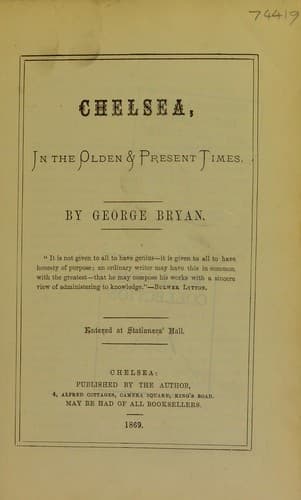
Chelsea, in the Olden & Present TimesBryan, George
History
Chelsea, in the Olden & Present Times
Bryan, George
Chelsea (London, England) -- History
Mr. Holland, in the year 1777, took a lease of one hundred acres of land,
called in old records Blacklands, of Charles, Lord Cadogan, which now
consists of Sloane Street, Cadogan Place, Hans Place, Exeter Street,
Ellis Street, D’Oyley Street, Sloane Square, George Street, &c. The
buildings were begun just at the commencement of the American war, owing
to which their progress was much impeded.
* * * * *
A very great improvement has at last been made at Grosvenor Bridge, in
ancient times called Blandel Bridge. Its name was probably corrupted to
“Bloody Bridge,” in consequence of the numbers of robberies and murders
formerly committed on this spot. The entrance here into the parish, at
the eastern end of Sloane Square, has been after years of delay
considerably widened, and some spacious shops erected. There is also now
an Underground Railway Station, and the West London Commercial Bank has
likewise extensive premises in Sloane Square, both of which will confer
very great advantages on the inhabitants of Chelsea, and the public in
general.
Trinity Church, Upper Chelsea.
This Church is situated at the south end of Sloane Street, near Sloane
Square. It is a brick structure of Gothic architecture, the western
front consisting of a centre flanked by two wide towers rising to a level
with the roof, and terminating with lofty octagonal spires. A large
entrance door occupies the space from tower to tower to the height of the
first division, giving access both to nave and aisles, over which stands
a large window separated by two mullions, with trefoil headings slightly
ornamented; above this is placed a circular stone surrounded by tracery,
intended, probably, at some future period for a clock. The towers to the
first blocking course are plain, but above they are enriched with
trefoil-headed windows, divided into two compartments, slender buttresses
separating the towers octagonally to the summit, crowned by a battlement
and surmounted by obtuse-headed pinnacles. At each side of the centre
great door there is a smaller one for ingress and egress to the aisles
and galleries.
* * * * *
The interior of the Church presents no peculiar feature requiring special
notice, at the same time it possesses in its design all that is essential
to impress the mind with the sacred character of the edifice. Those who
are unable to pay for a sitting have comfortable free seats provided for
them. The Church will probably accommodate 1500 persons. Attached to
it, on the right, is a spacious schoolroom, designed to correspond with
the architecture of the exterior of the Church. The whole of the schools
are very well attended.
* * * * *
Public-domain text, read in full here on John Shaqi.
Reviews
Reviews
No reviews yet
Be the first to share your thoughts on this work.
Elsewhere in the archive
Join the Discussion
Join the discussion
Sign in to leave a comment or review.
Sign InorCreate an account