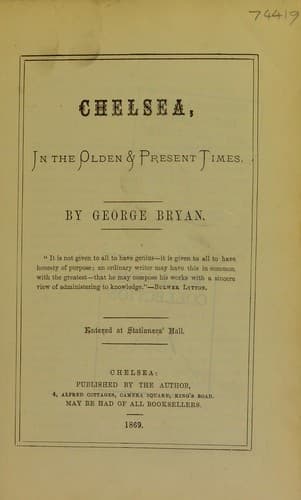
Chelsea, in the Olden & Present TimesBryan, George
History
Chelsea, in the Olden & Present Times
Bryan, George
Chelsea (London, England) -- History
BOTANIC GARDENS, SLOANE STREET.—This garden was first planned and laid
out in 1807, by Mr. Salisbury. The extent of ground was about six acres,
and formed a delightful promenade for company. In the original plan the
whole collection of plants was arranged according to the system of
Linnæus, and was disposed of in seventeen different compartments. When
Mr. Tate, in the year 1820, took possession of the premises, the
inhabitants, wishing to make it a public promenade, the above arrangement
was entirely superseded, and the interior of the ground laid out and
converted into a Nursery. Mr. Tate, however, still devoted the hothouses
and greenhouses to the raising of curious and rare exotics. Mr. Tuck,
nurseryman and seedsman, is now in possession of a portion of the ground,
but the whole presents a very different appearance to what it did many
years ago.
* * * * *
THE ROMAN CATHOLIC CHAPEL, situated in Cadogan Street, was built in 1811,
by voluntary subscriptions. Previous to the erection of this Chapel, the
Irish poor and others in Chelsea, as well as the Roman Catholic veterans
in the Royal Hospital, had not any place to resort to on Sundays, or at
such other times as they deemed it necessary to attend. Besides, there
were several families in the locality who considered the erection of the
Chapel indispensable. The Clergyman’s house adjoins the Chapel, and was
built at the expense of the Rev. Abbé Voyaux de Franous, D.D. On the
south of Cadogan Street, some short distance west of the Chapel, are the
Convent, the Schools, and the Burial Ground, the latter being now closed
for interments.
* * * * *
Upon the site of the west end of Cadogan Street stood an ancient house,
inhabited, in Bowack’s time, by Lady Matthews; it was afterwards known
for many years as the Marlborough Tavern and Cricket Grounds. It is
probable that the house was first established as a tavern during the
life-time of the great Duke of Marlborough, who, it is said, resided at
one time in Chelsea; hence Blenheim Street, &c., all contiguous.
* * * * *
The old Admiral Keppel Inn, with its tea gardens, was pulled down in
1856, on the site of which is now a large tavern.
* * * * *
CHELSEA COMMON was called in ancient records Chelsea Heath. It was
bounded on the north by the Fulham Road; on the east by Blacklands Lane,
now Marlborough Road; on the south by College Place, abutting on the
King’s Road; and on the west by Sydney Street. It was attached to the
Manor. Certain ancient houses, cottages, and farms, had a right of
pasturage for forty cows and twenty heifers. To keep these there was
always a cowkeeper, whose business it was to mark the cattle, to drive
home the cows at night to the several owners, and to impound all cattle
unmarked, or any horses which broke into the Common, or were found there.
Public-domain text, read in full here on John Shaqi.
Reviews
Reviews
No reviews yet
Be the first to share your thoughts on this work.
Elsewhere in the archive
Join the Discussion
Join the discussion
Sign in to leave a comment or review.
Sign InorCreate an account