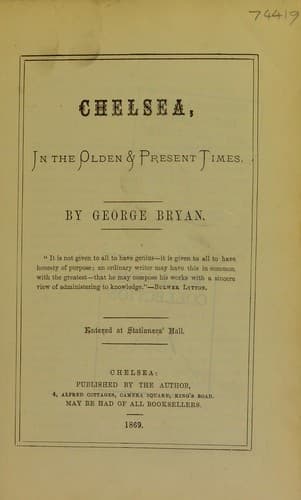
Chelsea, in the Olden & Present TimesBryan, George
History
Chelsea, in the Olden & Present Times
Bryan, George
Chelsea (London, England) -- History
{7} For on account of the presentation of these colours, see “Ranelagh,”
in a subsequent part of this work.
{19a} In 1534 he was attainted for denying the King’s supremacy, and
executed at Tyburn, the 7th of March in that year.—_Holinshed’s
Chronicle_.
{19b} He was ejected from the Rectory in 1554, for being a married
priest, but was restored by Queen Elizabeth.—_Strype’s Stowe_.
{19c} He gave, by will, £15 to the poor of this parish, and to the
repairing of the lead of the church. He was buried at Chelsea in 1615.
{23} From Dr. King’s MSS. it appears there had been a Clerk’s house and
school-rooms on this site previous to the erection of the present
building.
{26} There is on accidental mistake at page 3. The number of acres at
Kensal, belonging to the parish, should have been, as above, 137¾ acres.
{27} This ancient manor house stood on the site of Lawrence Street, near
the Old Church, and derived its name from having been the residence of
the Lawrence family for a long period.
{41} Mr. Thomas Bettsworth was well known to the parishioners and much
respected. He was Churchwarden at the New Church, and took an active
part in parochial affairs.
{57} Life of A. R. Bowes, Esq., by Jesse Foot.
{71} Earl Cadogan’s Records.
{72} I was well acquainted with these particulars, but for the sake of
accuracy I have taken an extract from “A Walk from Loudon to Fulham,” by
the late T. C. Croker, Esq., a work of great worth and highly
interesting. Published by William Tegg, London, 1860.
{82} See Old Church, page 14.
{85} Gent. Mag., 1753.
{87} Stephensiana, Monthly Magazine.
{100} Granger, vol. iv., p. 293.
{102} Gent. Mag. May, 1781.
{105} See History of the Manor, p. 24.
{107} Biog. Dram.
{108} Dr. Drake’s Essays.
{111} Pennant’s History of Whitford and Hollywell, p. 16.
{128} Mr. Goss, the present Organist of St. Paul’s Cathedral, was then
Organist of the Church.
{137} The Act specifies £20,000 and a Sixpenny Rate.
{144} In allusion to a very impressive sermon preached by the late Rev.
H. Blunt, from 1 Sam. xv. 14.
{147} The number that died of the plague this year in London was 30,578.
{150} The Writer’s father was one of the two Overseers of the Poor in
1805.
{153a} Drawn up in the hand-writing of the Rev. Dr. King, Rector.
{153b} We find mention of Bloody Gate and Bridge as early as the reign
of Queen Elizabeth. This spot was situated at the eastern entrance into
Sloane Square, and where Chelsea is divided from St. George’s, Hanover
Square.
{153c} The whole of the land, now the site of Sloane Street, was
anciently called “Blackland.” It extended as far as the Marlborough
Road, some few years since known as Blackland Lane.
{155} Gent. Mag., 1753.
{159} Annual Register, 1771, p. 160.
{177} Queen’s Road West was formerly called Paradise Row.
{184} Gent. Mag. 1747. pp. 298, 400.
{188} Rev. G. R. Gleig’s “Chelsea Hospital.”
{199} These Colours are deposited in the Old Church.
Public-domain text, read in full here on John Shaqi.
Reviews
Reviews
No reviews yet
Be the first to share your thoughts on this work.
Elsewhere in the archive
Join the Discussion
Join the discussion
Sign in to leave a comment or review.
Sign InorCreate an account