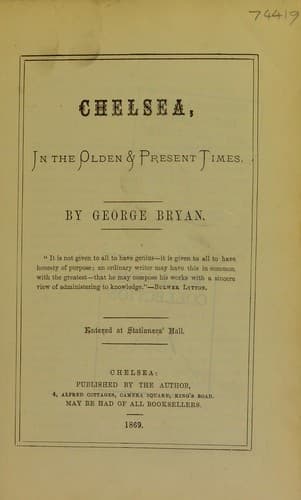
Chelsea, in the Olden & Present TimesBryan, George
History
Chelsea, in the Olden & Present Times
Bryan, George
Chelsea (London, England) -- History
Sir Arthur married, secondly, Lady Elizabeth, daughter of Henry, Earl of
Lincoln, by which marriage he became possessed of Sir Thomas More’s
house, which, in 1619, he conveyed to Lionel, Lord Cranfield. He died in
1625, leaving by his second wife six children. Lady Elizabeth Gorges,
his widow, in 1637, sold this estate to her daughter, Lady Elizabeth
Stanley, widow of Sir Robert Stanley, and confirmed the same by her will
in 1643, in which year she died. The family of Stanley appear to have
held possession of this estate, and resided here till the latter end of
the seventeenth century, when this branch of it became extinct, in the
male line, by the death of William Stanley, Esq. in 1691. The house was
rebuilt about this period; and, being left in an unfinished state, was
for several years unoccupied. It belonged, in 1724, to Henry Arundel,
Esq. Admiral Sir Charles Wager died here in 1743. It is said that this
gallant officer was educated a Quaker, and that though he left that
society, he was always particularly kind to its members.
* * * * *
After passing through several hands, Stanley House became the property of
Miss Southwell, afterwards the lady of Sir James Eyre, Lord Chief Justice
of the Common Pleas, who sold it in 1777 to the Countess of Strathmore,
one of the most intelligent female botanists of the age. Her ladyship
had begun to build extensive hothouses and conservatories, brought
exotics from the Cape, and was continually raising an increase to her
collections, when, by an unfortunate marriage, the cruel spoiler came,
and threw them like loathsome weeds away. The Countess married A. R.
Bowes, Esq., whose barbarities to her exceeded every thing recorded in
the annals of crime, and drew upon him the execrations of the whole
country. {57} After suffering innumerable indignities from her husband,
the Countess exhibited articles of the peace against him in the Court of
King’s Bench, and obtained a separation, under heavy securities. She
passed the remainder of her days in much affliction, both in body and
mind, and departed this life on the 20th April, 1800. Bowes died
miserably in a jail.
* * * * *
Stanley House was purchased of the Countess of Strathmore, by Mr. Lochee,
who kept the Military Academy at Little Chelsea, and was for some time in
the occupation of Richard Warren, M.D. This eminent physician was the
son of the Rev. Richard Warren, Archdeacon of Suffolk. He died in 1797,
and was buried in the chancel of Kensington Church, where a monument,
with a Latin inscription, was erected to his memory.
Public-domain text, read in full here on John Shaqi.
Reviews
Reviews
No reviews yet
Be the first to share your thoughts on this work.
Join the Discussion
Join the discussion
Sign in to leave a comment or review.
Sign InorCreate an account