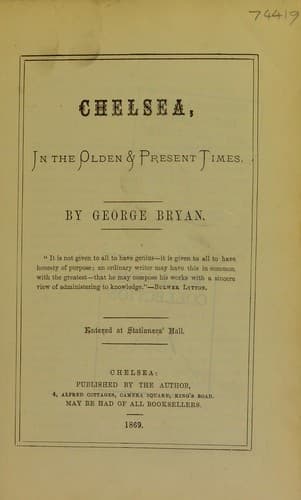
Chelsea, in the Olden & Present TimesBryan, George
History
Chelsea, in the Olden & Present Times
Bryan, George
Chelsea (London, England) -- History
Proceeding a little to the north-west, we arrive at what was formerly
called Little Chelsea, but which is now designated West Brompton.
Without wishing to remove our neighbour’s land-mark, or to trespass
beyond the precise boundaries of Chelsea, the parish of Kensington being
on the north side of West Brompton, we will notice the residence of
William Boscawen, Esq., who resided near to those spacious mansions now
being erected on the grounds formerly known as Walnut-Tree Walk, now
called Redcliffe Gardens. Mr. Boscawen was the younger son of General
George Boscawen, and was born in 1752. At an early age he was sent to
Eton, where he obtained the particular notice and favour of the
celebrated Dr. Barnard. From Eton he removed to Exeter College, Oxford,
and afterwards studied the law, became a member of the Middle Temple, and
was called to the bar. His legal studies were not unfruitful, as he
published an excellent book under the title of “A Treatise of Conviction
on Penal Statutes,” &c., 1792, 8vo. In 1785 he was appointed a
Commissioner of the Victualling Office, in consequence of which he soon
after quitted the bar, and in the following year married a daughter of
Dr. Ibbetson, Archdeacon of St. Albans. Being an excellent classical
scholar, and warmly attached to literary pursuits, Mr. Boscawen
published, in 1793, “A Translation of the Odes of Horace,” which, being
much approved of, was soon followed by a Translation of the Satires,
Epistles, and Art of Poetry. In 1801 he published a small volume of
Poems, which displayed an elegant taste, a poetical mind, and a correct
versification, and he was for several years an able coadjutor to the
British Critic. He died, after a short illness, in 1811. That excellent
institution, the Literary Fund, he considered almost as his child, and
his affection to it was testified not only by contribution, but by annual
verses in its praise, and assiduous attendance at its meetings.
* * * * *
Mr. Lochee’s Military Academy was established at this place about the
year 1770, and enjoyed a high degree of reputation; many of our most
eminent military characters received their education under him. The
premises, which were laid out as a regular fortification, and were opened
to view, excited much attention at the time. Mr. Lochee afterwards,
unfortunately, engaged in the revolutionary troubles which agitated
Flanders in the year 1790, and being taken prisoner by the Austrians, was
condemned to be hanged; he, however, obtained permission to come to
England, to settle his affairs, upon condition of leaving his only son as
a hostage; and upon his return to the Continent he suffered the
punishment of death. His son, afterwards, married a daughter of the late
Mr. King, an eminent book auctioneer, of King Street, Covent Garden, and,
lamentable to relate, fell by his own hands.
* * * * *
Public-domain text, read in full here on John Shaqi.
Reviews
Reviews
No reviews yet
Be the first to share your thoughts on this work.
Elsewhere in the archive
Join the Discussion
Join the discussion
Sign in to leave a comment or review.
Sign InorCreate an account