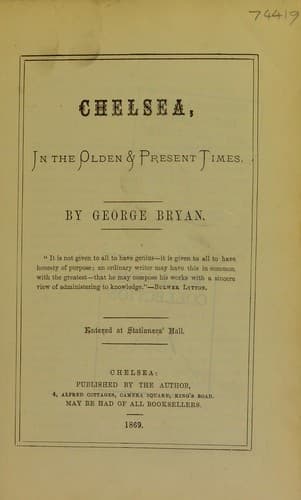
Chelsea, in the Olden & Present TimesBryan, George
History
Chelsea, in the Olden & Present Times
Bryan, George
Chelsea (London, England) -- History
Sir James Wishart resided in Little Chelsea, and died in May, 1723. He
was a native of Scotland, and was made an Admiral by Queen Anne; in 1710
he became a Lord Commissioner of the Admiralty, in which year he was
returned Member of Parliament for Portsmouth. The Queen also conferred
the honour of knighthood upon him; but, in the following reign, he lost
all his places, and was dismissed from the service, for favouring the
interest of the Pretender.
* * * * *
Admiral Sir John Balchen, another distinguished naval officer, resided in
Little Chelsea about 1723. He was lost in the “Victory” in the year
1744. Sir John sailed, in July, from Spithead with a strong squadron, in
quest of an opportunity to attack the French fleet at Brest, under the
command of M. de Rochambault. In the Bay of Biscay he was overtaken by a
violent storm that dispersed the ships, and drove them up the English
Channel. Admiral Stewart, with the greater part of them, arrived at
Plymouth; but Sir John Balchen’s own ship, the Victory, which was at that
time considered to be the most beautiful first rate in the world,
foundered at sea; and this brave officer perished, with all his officers,
volunteers, and crew, amounting to eleven hundred choice seamen.
* * * * *
The Right Hon. Edward Hyde, third Earl of Clarendon, died at his house at
Little Chelsea in 1723. He married Catherine, daughter to Henry Lord
O’Brien, eldest son and heir to the Earl of Thomond, of Ireland, by whom
he had a son and two daughters. The title descended to the Earl of
Rochester, and soon after became extinct.
* * * * *
FATAL DUEL.—In January, 1784, a duel was fought in a field near Little
Chelsea, between Captain Charles Mostyn, of the navy, and Captain Clarke,
of the African Corps, which terminated in the death of the former, who
was shot through the heart. The quarrel originated in defence of a Jew,
who went about diverting company, by taking off Mr. Fox. Some words
arising, Captain Clarke demanded an apology, which Captain Mostyn
declined to make to him. Mr. Mostyn was a gallant officer, only 25 years
of age, who, for his intrepid behaviour, had been made post-captain in
the Solitaire, a French ship of the line, taken by the Ruby. Happily for
the humanity of England, such dark blots on its history are now for ever
erased, by the adoption of more stringent laws and the advancement of
religious and moral principles.
* * * * *
Public-domain text, read in full here on John Shaqi.
Reviews
Reviews
No reviews yet
Be the first to share your thoughts on this work.
Elsewhere in the archive
Join the Discussion
Join the discussion
Sign in to leave a comment or review.
Sign InorCreate an account