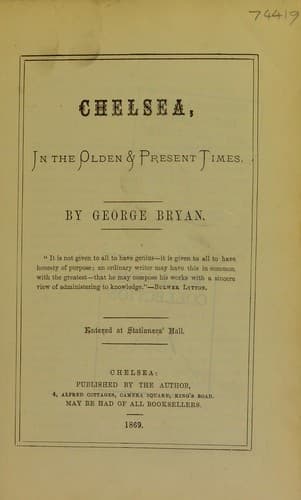
Chelsea, in the Olden & Present TimesBryan, George
History
Chelsea, in the Olden & Present Times
Bryan, George
Chelsea (London, England) -- History
Dr. Baldwin Hamey was born in 1600. He retired to Little Chelsea from
the hurry of his profession the year before the Fire of London, saving
thereby his library; he also escaped from the direful effects of the
plague in London. At Chelsea he contributed largely towards the erection
of the church steeple, and gave the great bell which had his name on it.
I may here state that the first large bells are mentioned by Bede, in the
year 680. Before that period the early British Christians made use of
wooden rattles (sacra ligna) to call the congregation of the faithful
together. Dr. Adam Littleton, in gratitude to Dr. Hamey for the above
benefactions, printed at the end of the first edition of his Latin
Dictionary, a copy of Latin verses which he dedicated to him. Dr. Hamey
was a great scholar, a philosopher, and an eminent physician. At his
death he bequeathed to the College of Physicians the estate of Ashlins,
in Essex, besides money and books. There is a manuscript life of him,
written about 143 years ago, by his relation, Mr. Palmer. “Chemistry,”
says the biographer, “now began to come into vogue, which Dr. Hamey could
not well be reconciled to, from his Galenical principles, and at his age.
It seemed to him to be a stroke of quackery.” He declined a knighthood,
and the offer of being first physician to Charles II. after his
restoration. The same modesty made him waive the offer of being
President of his beloved College of Physicians, although he had held all
other subordinate offices in it. He died in 1676, and was buried in the
Old Church.
* * * * *
The Goat and Boots Tavern still stands at the eastern corner of Park
Walk, West Brompton, or Little Chelsea, although from its age it seems
probable that in a few years a new house will be substituted for it. The
sign was originally painted by Morland, to pay his tavern bill. In old
deeds it is called the Goat. Perhaps poor Morland added the “Boots” to
the sign to make it more attractive, and to get a better price from the
proprietor, but this is mere conjecture.
* * * * *
Park Walk, in a very old map of Chelsea, is called Lovers’ Walk, and it
appears to have been planted with trees, but from some unknown
cause—surely all the loving lads and lasses had not left the parish—it
degenerated into Twopenny Walk. After dark, from its retirement and
seclusion, it was dangerous for persons passing that way. It has been
now for many years a good thoroughfare from the King’s Road to West
Brompton, having Park Chapel in a central position, and houses on both
sides of the road. When the improvement at the bottom of Milman’s Row is
entirely completed, there will then be an excellent and continuous
roadway to the river-side.
Park Chapel, &c.
Public-domain text, read in full here on John Shaqi.
Reviews
Reviews
No reviews yet
Be the first to share your thoughts on this work.
Elsewhere in the archive
Join the Discussion
Join the discussion
Sign in to leave a comment or review.
Sign InorCreate an account