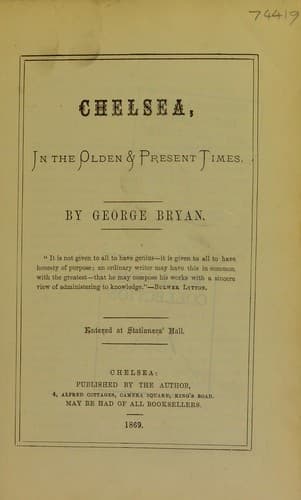
Chelsea, in the Olden & Present TimesBryan, George
History
Chelsea, in the Olden & Present Times
Bryan, George
Chelsea (London, England) -- History
After the death of the Countess of Devonshire, this ancient house became
the property of Sir Joseph Alston, who was created a baronet by Charles
II. in 1682. Mrs. Mary Alston, the wife of this gentleman, died here in
1671, and her funeral sermon was preached by Dr. Littleton, who published
it shortly after, in quarto. Sir Joseph was in possession of this house
in 1664; it afterwards came into the possession of Mr. Tate, and was
occupied as a stained paper manufactory.
* * * * *
In 1813 it was pulled down, and the materials sold by a builder, who had
obtained possession; and now not a stone remains to show where it once
stood.
* * * * *
The family of Tate were originally of Chelsea, and had at one time large
property here, which they parted with by degrees. They attained property
also in Leicestershire, through a marriage with the daughter of Lord
Zouch.
Bishop of Winchester’s Palace.
The Bishop of Winchester’s Palace, which was pulled down some years
since, adjoined the gardens of Alston House, on the east, and on the site
of which is now Oakley Street, and a terrace of well-built houses,
fronting the river. The houses erected in Oakley Street are throughout
of a superior class, and as the road is of considerable width, with a
good pavement, it now forms the most respectable and important direct
thoroughfare from the King’s Road to the centre of Cheyne Walk. The
contemplated embankment and Albert Bridge will be noticed at the
conclusion of this work, so as to get correct information.
* * * * *
The ancient palace of the Bishops of Winchester, in Southwark, having
been dilapidated and laid waste, an Act of Parliament was passed in the
year 1663 empowering George Morley, Bishop of Winchester, to lease out
the houses in Southwark, and for other purposes. In the ensuing year the
Bishop, in pursuance of this Act of Parliament, purchased a new brick
house at Chelsea, then lately built by James Duke of Hamilton, and
adjoining to the Manor House, Cheyne Walk, on the east, and Alston House,
on the west, for £4250, to be the future residence of the bishops of this
see, and to be called Winchester House. By the Act it was held to be
within the diocese of Winchester.
* * * * *
The Bishopric of Winchester is of good antiquity, and has never changed
the see since its foundation. The Bishops are Chancellors of the see of
Canterbury, and Prelates of the most noble Order of St. George, called
the Garter, which office was vested in them by King Edward III. at the
establishment of that noble Order, and has continued with them ever
since. Anciently, they were reputed Earls of Southampton, and are so
styled in the Statutes of the Garter, made by Henry VIII.
BISHOPS SINCE THE RESTORATION OF KING CHARLES II.
Public-domain text, read in full here on John Shaqi.
Reviews
Reviews
No reviews yet
Be the first to share your thoughts on this work.
Elsewhere in the archive
Join the Discussion
Join the discussion
Sign in to leave a comment or review.
Sign InorCreate an account