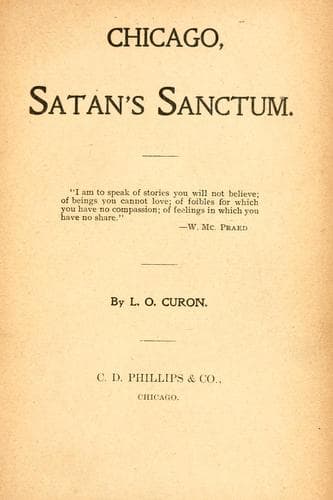
Crime -- Illinois -- Chicago; Police corruption -- Illinois -- Chicago; Political corruption -- Illinois -- Chicago
Acting upon the demand of his party for the repeal of this law, the
Corporation Counsel began his attacks upon it by a multiplicity of
opinions calculated to gradually remove it from the statute book.
Ordinances were passed in accordance with these opinions, creating new
heads of departments and exempting them from the civil service rules.
Positions, filled by civil service appointees, were abolished. The same
positions were re-created under a new name, filled by a sixty day man who
was then examined, and certified to the head of the list. The police
department, the city treasurer, and other branches of the local government
which have attempted by judicial proceedings to emasculate the civil
service law, have in every instance been foiled by the decisions of the
Supreme Court.
The Special Assessment Bureau of the board of public works, has for many
years, in conjunction with the alderman, had the origination and passage
of ordinances for paving streets, laying sewers, sidewalks, drains, water
supply and service pipes, etc. Under a law recently enacted, and now in
force, all ordinances originate with a board, named the Board of Local
Improvements. The right of petition on behalf of the property owners, is a
feature of the new law which smiles at the property owner, while it "winks
the other eye." It holds out a hope, as do other provisions of the law, of
reduced assessments, but, so far, the practical benefit to the owner of
real estate has not been made apparent. Since the year 1861 and including
the year 1897, the enormous sum of $90,402,790.44 has been levied upon
real estate for the payment of public improvements. During the year ending
December, 1891, the amount levied was over six millions of dollars, and
during the following year ending December 31, 1892, just preceding the
World's Fair, the assessments reached the sum of over fourteen millions of
dollars. Reference has already been made to frauds in the letting of
contracts for street improvements. They are split up and let to favorites
without advertising, so that each payment will fall under $500, although
the improvement may be a mile in length. The asphalt ring is just as
potent as ever. It fights every effort of other dealers in asphalt to
procure a contract and it generally succeeds in foisting upon the people
its quality of asphalt at a higher price than that offered at a lower
price, by other bidders, perhaps equally as good in quality and which has
been successfully used in other cities. Failing recently to stampede the
board, the ring accepted contracts at a figure submitted by its
competitors. This, however, is a familiar trick of trusts, and will last
for a very short period of time, unless the board manifests a disposition
to consider the merits of the material of competing contractors. The ring
will not abandon its struggle so easily. It is powerful, uniting in its
behalf the combined efforts of politicians of all parties, who are
Public-domain text, read in full here on John Shaqi.
Reviews
Reviews
No reviews yet
Be the first to share your thoughts on this work.
Elsewhere in the archive
Join the Discussion
Join the discussion
Sign in to leave a comment or review.
Sign InorCreate an account