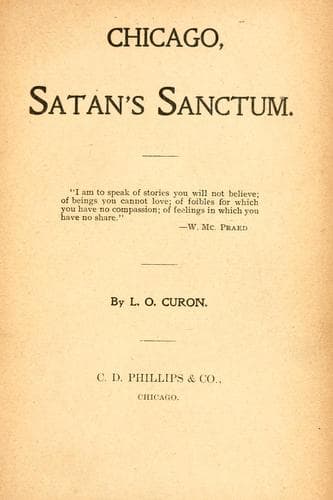
Crime -- Illinois -- Chicago; Police corruption -- Illinois -- Chicago; Political corruption -- Illinois -- Chicago
On the last day of the special session, no legislation having been enacted
on the subject of the proposed bill, a resolution was introduced providing
for a continuance of the committee, which recited that it had "unearthed a
most deplorable state of affairs in the management and control of the
police force of Chicago," and that "the most flagrant violations of the
civil service law have been brazenly practiced by those in authority in
control of that police force." Nothing resulted from the latter resolution
continuing the committee.
The report covered the investigations of the committee into the
operations of the civil service law, and the manner of its enforcement,
finding that it was a plaything in the hands of the party then in power,
and an object of constant and premeditated attack. It also found the
grossest abuses in the management of the police pension fund and in the
workings of the police force as an organization. That crime was protected
and lewdness tolerated by it, and that in fact it was a powerful ally of
the criminal classes, and practically made an unofficial livelihood off
unfortunate women of the town, thieves and their fences, gambling resorts
and their keepers, and the patrons and keepers of the all night saloons.
It found the Chief of Police was cognizant of the facts, and yet took no
steps to correct them. That Chief from whose testimony quotations appear
in these pages, was re-appointed to command the police force for the next
two years.
The findings of this committee made but little, if any, impression upon
the public mind. There were no revelations as to the condition of criminal
affairs, and the relations of the police therewith, which were new to the
people, with the possible exception, perhaps, that it was not known how
utterly inefficient and irresponsible the Chief of Police was. From that
moment every newspaper has, if not demanded, at least suggested his
removal from office. In this respect it but voices the sentiments of the
entire community. It is a paradox why, in the face of this public feeling,
a majority of the people supported for re-election the staunch friend of
the dishonored head of the police force, unless upon the hypothesis that
he would not continue to be a part of the new administration. If so, the
hypothesis soon failed. The Mayor thought he would "hold him for a while."
Public-domain text, read in full here on John Shaqi.
Reviews
Reviews
No reviews yet
Be the first to share your thoughts on this work.
Elsewhere in the archive
Join the Discussion
Join the discussion
Sign in to leave a comment or review.
Sign InorCreate an account