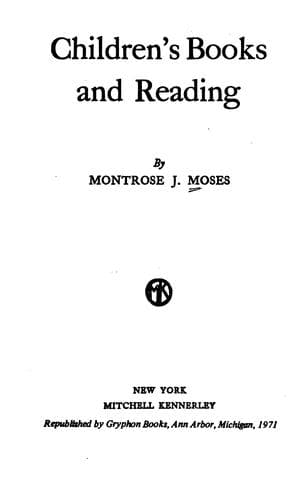
Children -- Books and reading; Children's literature -- Bibliography; Children's literature -- History and criticism
A story is told of Charles Lamb which, in view of actual facts, one
must necessarily disbelieve. It is to the effect that, dining out one
evening, he heard in an adjoining room the noise of many children. With
his glass filled, he rose from his chair and drank the toast, “Here’s
to the health of good King Herod.” Instinctively, those familiar with
Elia will recollect his “Dream Children,” and wonder how any critic
could reconcile the two attitudes. Lamb had an abiding love for young
people and a keen understanding of their natures.
As writers of juvenile literature, Charles (1775–1834) and Mary
(1765–1847) Lamb might never have been known, had it not been for
William Godwin (1756–1836) and his second wife. The two began a
publishing business, in 1805, under the firm name of M. J. Godwin
and Company. The only details that concern us are those which began
and ended with the Lambs and their work. Godwin, himself, under the
pseudonym of Baldwin, turned out literary productions of various kinds.
But though, during one period, there was every sign of a flourishing
trade, by 1822 the business was bankrupt.
The Lambs regarded their writings for children as pot-boilers; letters
from them abound with such confessions. But it was in their natures to
treat their work lovingly; their own personalities entered the text;
they drew generously upon themselves; and so their children’s books
are filled with their own experiences, and are, in many respects,
as autobiographical as the “Essays of Elia.” Mary undertook by far
the larger number of the volumes which are usually accredited to her
brother; in fact, wherever the two collaborated, Lamb occupied a
secondary place.
The following list indicates the division of labour:
THE KING AND QUEEN OF HEARTS, 1805. Lamb’s first juvenile work.
TALES FROM SHAKESPEARE, 1807. Lamb wrote to Manning, May 10, 1806:
“I have done ‘Othello’ and ‘Macbeth,’ and mean to do all the
tragedies. I think it will be popular among the little people,
besides money.”
ADVENTURES OF ULYSSES, 1808. “Intended,” as Lamb told Manning, “to
be an introduction to the reading of Telemachus; it is done out
of the ‘Odyssey,’ not from the Greek. I would not mislead you;
nor yet from Pope’s ‘Odyssey,’ but from an older translation of
one Chapman. The ‘Shakespeare Tales’ suggested doing it.” Lamb’s
delight in Chapman was as unalloyed as that of Keats.
MRS. LEICESTER’S SCHOOL, 1809. Issued anonymously, hence commonly
ascribed to Lamb. The greater part of the work belongs to Mary; it
seems to have been her idea originally. Lamb to Barton, January 23,
1824: “My Sister’s part in the Leicester School (about two-thirds)
was purely her own; as it was (to the same quantity) in the
Shakespeare Tales which bear my name. I wrote only the Witch Aunt,
the First Going to Church, and the final story about a little
Indian Girl in a Ship.”
Public-domain text, read in full here on John Shaqi.
Reviews
Reviews
No reviews yet
Be the first to share your thoughts on this work.
Elsewhere in the archive
Join the Discussion
Join the discussion
Sign in to leave a comment or review.
Sign InorCreate an account