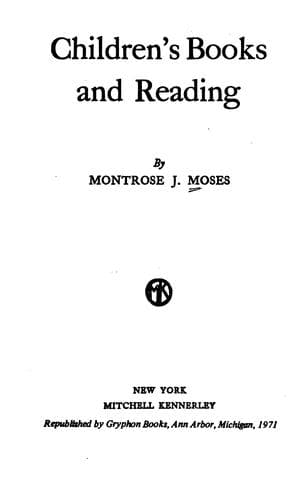
Children -- Books and reading; Children's literature -- Bibliography; Children's literature -- History and criticism
To-morrow new topics may be introduced into our juvenile literature,
but change takes longer than a day to become apparent. The student who
attempts to reach any scientific estimate of the present trend will
be disappointed; the mass is too conglomerate, and there are too many
authors writing children’s books for money rather than for children.
I have followed the course as carefully as I could, noting the slight
alterations in concepts to accord with the varying conditions. But
there is no principle that can be deduced, other than the educational
one. The changes are confined to points of external interest, not
of spiritual or mental significance. For instance, there was a time
when girls’ literature and boys’ literature were more clearly
differentiated, one from the other; their near approach has been due to
a common interest in outdoor exercises. Again, things practical, things
literal have crowded out the benignant figure of Santa Claus; and in
the stead, the comic supplement of the Sunday newspaper furnishes
pictures that well-nigh stifle the true domain once occupied by “Mother
Goose.”
What would a parent do, asked suddenly to deal with a promiscuous
collection of juvenile books? Would she unerringly reach forth for
the volume most likely to please her son’s or her daughter’s taste?
If she were to claim little difference between the one college story
she had read, and the several hundred she had not read, she would
not be far from wrong. But we cannot tell how deep an impression the
present activity among writers for children will have on the future.
Our temptation is to make the general statement that the energy is a
surface one, that no great writing is being done for children because
it has become an accessory rather than an end in itself. Education
saved us from the moral pose; it must not deny us the realm of
imagination and fancy.
FOOTNOTES:
[41] In education, the influence of Froebel, in direct descent from
Rousseau, is to be considered.
[42] D. N. B.--Dictionary of National Biography.
[43] The student who desires to investigate the history of American
school-books will find much valuable material in the Watkinson Library
of Hartford, Conn., to which institution Dr. Henry Barnard’s entire
collection of school-books was left. _Vide_ Bibliotheca Americana,
Catalogue of American Publications, including reprints and original
works, from 1820 to 1852, inclusive, together with a list of
periodicals published in the United States, compiled and arranged by
Orville A. Roorbach, N. Y., Oct., 1852. Includes Supplement to 1849
ed., published in 1850.
_Vide_ also Early English School-books. Educational Library, South
Kensington Museum.
Public-domain text, read in full here on John Shaqi.
Reviews
Reviews
No reviews yet
Be the first to share your thoughts on this work.
Elsewhere in the archive
Join the Discussion
Join the discussion
Sign in to leave a comment or review.
Sign InorCreate an account