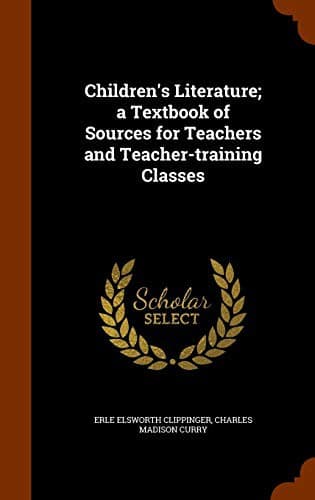
Children's Literature: A Textbook of Sources for Teachers and Teacher-Training ClassesCurry, Charles Madison
General
Children's Literature: A Textbook of Sources for Teachers and Teacher-Training Classes
Curry, Charles Madison
Children -- Books and reading; Children's literature -- Study and teaching
"They are waiting outside with the canopy which is to be carried over
your Majesty in the procession," said the master of ceremonies.
"I am ready," said the Emperor. "Don't the clothes fit well?" he asked,
giving a last glance into the mirror as though he were looking at all
his new finery.
The men who were to carry the train of the Emperor's cloak stooped down
to the floor as if picking up the train, and then held it high in the
air. They did not dare let it be known that they could see nothing.
So the Emperor marched along under the bright canopy. Everybody in the
streets and at the windows cried out: "How beautiful the Emperor's new
clothes are! What a fine train! And they fit to perfection!"
No one would let it be known that he could see nothing, for that would
have proved that he was unfit for office or that he was very, very
stupid. None of the Emperor's clothes had ever been as successful as
these.
"But he has nothing on!" said a little child.
"Just listen to the innocent!" said its father.
But one person whispered to another what the child had said. "He has
nothing on! A child says he has nothing on!"
"But he has nothing on!" at last cried all the people.
The Emperor writhed, for he knew that this was true. But he realized
that it would never do to stop the procession. So he held himself
stiffer than ever, and the chamberlains carried the invisible train.
194
In his story "The Nightingale," Andersen
suggests that the so-called upper class of
society may become so conventionalized as to be
unable to appreciate true beauty. Poor
fishermen and the little kitchen girl in the
story recognize the beauty of the exquisite
song of the nightingale, and Andersen shows his
regard for royalty by having the emperor
appreciate it twice. The last part of the story
is especially impressive. When Death approached
the emperor and took from him the symbols that
had made him rank above his fellows, the
emperor saw the realities of life and again
perceived the beauty of the nightingale's song.
This contact with real life made Death shrink
away. Then the emperor learned Andersen's
message to artificial society: If you would
behold true beauty, you must have it in your
own heart.
THE NIGHTINGALE
HANS CHRISTIAN ANDERSEN
Public-domain text, read in full here on John Shaqi.
Reviews
Reviews
No reviews yet
Be the first to share your thoughts on this work.
Elsewhere in the archive
Join the Discussion
Join the discussion
Sign in to leave a comment or review.
Sign InorCreate an account