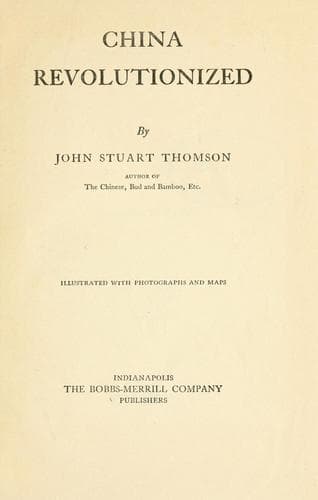
The writer in the Antiquity chapter of a former book adopted the
Biblical account of the creation, that the original Chinese (Chou
clan’s ancestors) spread through Turkestan, along the Tarim valley, to
their first known home in Shensi province. Doctor Stein has found on
the site of the ruined temple of Hangayi Tuti at Khoten, in Chinese
Turkestan, birchbark and other manuscript in an unknown language. These
point the way to a further search. The Asiatic Society, of Bengal,
Calcutta, has acquired from a Montenegrin gentleman, who traveled in
Turkestan, five leaves of brownish yellow manuscripts eight by six
inches, in an unknown language, which wait to reveal possible wonders
of China’s prehistoric story. The pages show that they were one part
of an extensive work now lost in the sands and camp ashes of central
Asia. There is room for emulation by America, Britain and China of
Russia’s archeological research in Chinese Turkestan, for the world
wants to know more of ancient China, now that the New China has
become important. The professors of the American colleges in China
are sufficiently learned to make a beginning in preserving China’s
antiquities, which are now in great danger of being lost forever. The
rage, as far as the Chinese themselves are concerned, is altogether for
the new and utilitarian. The modernized Chinese have already forgotten
their conservative Hanlin Academy.
XX
LIFE OF FOREIGNERS IN CHINA
I know of no place where music, lanterns, romantic mountain scenery,
seascapes far below and delightful society in an alien setting combine
more pleasantly than at the Peak Club, Hongkong. Above the passing
clouds which now and then whirl around as in Rubens’ pictures, over the
purple Pacific Ocean which foams around hilly islands, over the high
hills as you ascend from the royal colony of Victoria, on a terrace,
they have graded a velvet lawn. Here the military and naval bands are
brought for a promenade concert in the soft night of the fragrant
Orient, beneath Bowring’s “wide Cathayan tree”. The band of the Royal
Welsh Fusiliers, from Mt. Austin barracks, plays the stirring Welsh
national march, _The Men of Harlech_. The men sing the chorus:
“See! the bonfire light before ye,
How its fiery tongues do call ye,
Come as one to death or glory,
Heroes of the fight.
“Lest by fire they kill and plunder,
Harlech! Harlech! make them wonder
At thy power that none can sunder;
Freedom thou wilt give.”
Public-domain text, read in full here on John Shaqi.
Reviews
Reviews
No reviews yet
Be the first to share your thoughts on this work.
Elsewhere in the archive
Join the Discussion
Join the discussion
Sign in to leave a comment or review.
Sign InorCreate an account