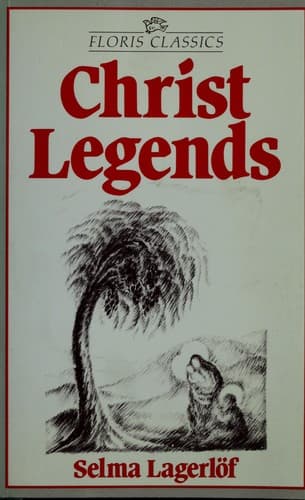
Jesus Christ -- Fiction; Jesus Christ -- Juvenile fiction; Short stories
At the entrance gate stood the traveler. He was a large elderly man with
broad shoulders and a heavy and gloomy appearance.
The dreamer recognized the stranger instantly, and whispered to her
husband: “It is Cæsar Tiberius, who is here in Jerusalem. It can not be
any one else.”
“I also seem to recognize him,” said her husband; at the same time he
placed his finger on his mouth, as a signal that they should be quiet
and listen to what was said down in the court.
They saw that the doorkeeper came out and asked the stranger: “Whom seek
you?”
And the traveler answered: “I seek the great Prophet of Nazareth, who is
endowed with God’s power to perform miracles. It is Emperor Tiberius who
calls him, that he may liberate him from a terrible disease, which no
other physician can cure.”
When he had spoken, the slave bowed very humbly and said: “My lord, be
not wroth! but your wish can not be fulfilled.”
Then the Emperor turned toward his slaves, who waited below in the
court, and gave them a command.
Then the slaves hastened forward—some with handfuls of ornaments,
others carried goblets studded with pearls, other again dragged sacks
filled with gold coin.
The Emperor turned to the slave who guarded the gate, and said: “All
this shall be his, if he helps Tiberius. With this he can give riches to
all the world’s poor.”
But the doorkeeper bowed still lower and said: “Master, be not wroth
with thy servant, but thy request can not be fulfilled.”
Then the Emperor beckoned again to his slaves, and a pair of them
hurried forward with a richly embroidered robe, upon which glittered a
breastpiece of jewels.
And the Emperor said to the slave: “See! This which I offer him is the
power over Judea. He shall rule his people like the highest judge, if he
will only come and heal Tiberius!”
The slave bowed still nearer the earth, and said: “Master, it is not
within my power to help you.”
Then the Emperor beckoned once again, and his slaves rushed up with a
golden coronet and a purple mantle.
“See,” he said, “this is the Emperor’s will: He promises to appoint the
Prophet his successor, and give him dominion over the world. He shall
have power to rule the world according to his God’s will, if he will
only stretch forth his hand and heal Tiberius!”
Then the slave fell at the Emperor’s feet and said in an imploring tone:
“Master, it does not lie in my power to attend to thy command. He whom
thou seekest is no longer here. Pilate hath killed him.”
VIII
When the young woman awoke, it was already full, clear day, and her
female slaves stood and waited that they might help her dress.
She was very silent while she dressed, but finally she asked the slave
who arranged her hair, if her husband was up. She learned that he had
been called out to pass judgment on a criminal. “I should have liked to
talk with him,” said the young woman.
Public-domain text, read in full here on John Shaqi.
Reviews
Reviews
No reviews yet
Be the first to share your thoughts on this work.
Elsewhere in the archive
Join the Discussion
Join the discussion
Sign in to leave a comment or review.
Sign InorCreate an account