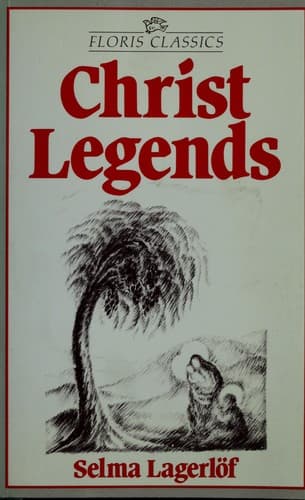
Jesus Christ -- Fiction; Jesus Christ -- Juvenile fiction; Short stories
Then the old woman perceived that Tiberius had never expected any help
from the Prophet of Nazareth.
“Why did you let me make the journey to that distant land, if you
believed all the while that it was useless?”
“You are the only friend I have,” said the Emperor. “Why should I deny
your prayer, so long as I still have the power to grant it.”
But the old woman did not like it that the Emperor had taken her for a
fool.
“Ah! this is your usual cunning,” she burst out. “This is just what I
can tolerate least in you.”
“You should not have come back to me,” said Tiberius. “You should have
remained in the mountains.”
It looked for a moment as if these two, who had clashed so often, would
again fall into a war of words, but the old woman’s anger subsided
immediately. The times were past when she could quarrel in earnest with
the Emperor. She lowered her voice again; but she could not altogether
relinquish every effort to obtain justice.
“But this man was really a prophet,” she said. “I have seen him. When
his eyes met mine, I thought he was a god. I was mad to allow him to go
to his death.”
“I am glad you let him die,” said Tiberius. “He was a traitor and a
dangerous agitator.”
Faustina was about to burst into another passion—then checked herself.
“I have spoken with many of his friends in Jerusalem about him,” said
she. “He had not committed the crimes for which he was arraigned.”
“Even if he had not committed just these crimes, he was surely no better
than any one else,” said the Emperor wearily. “Where will you find the
person who during his lifetime has not a thousand times deserved death?”
But these remarks of the Emperor decided Faustina to undertake something
which she had until now hesitated about. “I will show you a proof of his
power,” said she. “I said to you just now that I laid my kerchief over
his face. It is the same kerchief which I hold in my hand. Will you look
at it a moment?”
She spread the kerchief out before the Emperor, and he saw delineated
thereon the shadowy likeness of a human face.
The old woman’s voice shook with emotion as she continued: “This man saw
that I loved him. I know not by what power he was enabled to leave me
his portrait. But mine eyes fill up with tears when I see it.”
The Emperor leaned forward and regarded the picture, which appeared to
be made up of blood and tears and the dark shadows of grief. Gradually
the whole face stood out before him, exactly as it had been imprinted
upon the kerchief. He saw the blood-drops on the forehead, the piercing
thorn-crown, the hair, which was matted with blood, and the mouth whose
lips seemed to quiver with agony.
He bent down closer and closer to the picture. The face stood out
clearer and clearer. From out the shadow-like outlines, all at once, he
saw the eyes sparkle as with hidden life. And while they spoke to him of
the most terrible suffering, they also revealed a purity and sublimity
which he had never seen before.
Public-domain text, read in full here on John Shaqi.
Reviews
Reviews
No reviews yet
Be the first to share your thoughts on this work.
Elsewhere in the archive
Join the Discussion
Join the discussion
Sign in to leave a comment or review.
Sign InorCreate an account