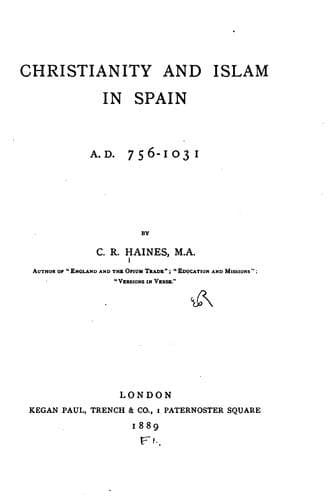
Christianity and Islam in Spain, A.D. 756-1031Haines, Charles Reginald
Islamic
Christianity and Islam in Spain, A.D. 756-1031
Haines, Charles Reginald
Christian martyrs -- Spain; Christianity -- Spain; Islam -- Spain
There is abundant evidence to show that the party of enthusiasts, both
those who offered themselves for martyrdom, and those who aided and
abetted their more impulsive brethren, were a comparatively small body
in the Church of Spain; and that their proceedings awakened little short
of dismay in the minds of the more sensible portion of the Christian
community, both in the Arab part of Spain, and perhaps in a less degree
in the free North.[2] The chief leaders of the party of zealots--as far
as we find mention of them--were Saul, bishop of Cordova (850-861),
Eulogius, and Samson, abbot of the monastery of Pegnamellar; while
Reccafredus, bishop of Seville, and Hostegesis of Malaga, were the
prominent ecclesiastics on the other side.
[1] Ibn Khatib, apud Dozy, ii. 210.
[2] Yonge, p. 63.
Before relating what steps the latter took in conjunction with the
Moslem authorities to put down the dangerous outbreak of fanaticism, it
will be interesting to note what was the attitude of the different
sections of the Church towards the misguided men who gave themselves up
to death, and their claims to the crown of martyrdom. Those who denied
the validity of these claims, rested their contention on the grounds,
that the so-called martyrs had compassed their own destruction, there
being no persecution at the time; that they had worked no miracles in
proof of their high claims; that they had been slain by men who believed
in the true God; that they had suffered an easy and immediate death; and
that their bodies had corrupted like those of other men.
It was an abuse of words, said the party of moderation, to call these
suicides by the holy name of martyrs, when no violence in high places
had forced them to deny their faith,[1] or interfered with their due
observance of Christianity. It was merely an act of ostentatious
pride--and pride was the root of all evil--to court danger. Such conduct
had never been enjoined by Christ, and was quite alien from the meekness
and humility of His character.[2]
They might have added that such voluntary martyrdoms had been expressly
condemned,
(_a._) By the circular letter of the Church of Smyrna to the other
churches, describing Polycarp's martyrdom, in the terms: "We commend not
those who offer themselves of their own accord, for that is not what the
gospel teacheth us:"[3]
(_b._) By St Cyprian,[4] who, when brought before the consul and
questioned, said "our discipline forbiddeth that any should offer
themselves of their own accord;" and in his last letter he says: "Let
none of you offer himself to the pagans, it is sufficient if he speak
when apprehended:"
(_c._) By Clement of Alexandria: "We also blame those who rush to death,
for there are some, not of us, but only bearing the same name, who give
themselves up:"[5]
(_d._) Implicitly by the synod of Elvira, or Illiberis (_circa_ 305),
one of the canons of which forbade him to be ranked as a martyr, who
was killed on the spot for breaking idols:
Public-domain text, read in full here on John Shaqi.
Reviews
Reviews
No reviews yet
Be the first to share your thoughts on this work.
Elsewhere in the archive
Join the Discussion
Join the discussion
Sign in to leave a comment or review.
Sign InorCreate an account