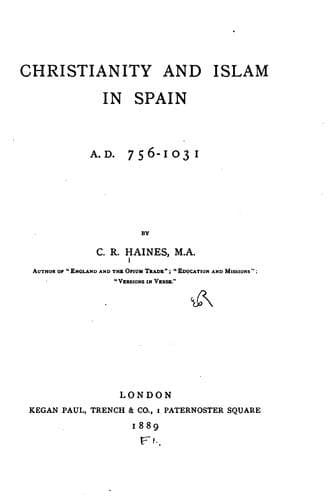
Christianity and Islam in Spain, A.D. 756-1031Haines, Charles Reginald
Islamic
Christianity and Islam in Spain, A.D. 756-1031
Haines, Charles Reginald
Christian martyrs -- Spain; Christianity -- Spain; Islam -- Spain
(_e._) By Mensurius, bishop of Carthage, who, when consulted on the
question of reducing the immense lists of acknowledged martyrs, gave it
as his opinion that those should be first excluded who had courted
martyrdom.[6] One bishop alone, and he a late one, Benedict XIV. of
Rome,[7] has ventured to approve what the Church has condemned. Nor is
this the only instance in which the Roman Church has set aside the
decisions of an earlier Christendom.
[1] Eul., "Mem. Sanct.," i., sec. 18, "Quos nulla praesidalis
violentia fidem suam negare compulit, nec a cultu sanctae
piaeque religionis amovit:" sec. 23, "Quos liberalitas regis
suum incolere iusserat Christianismum."
[2] Quoting such texts as Matt. v. 44, "Bless them that curse
you, and pray for them that despitefully use you:" Pet. ii. 23,
"Submit yourselves to every ordinance of man for the Lord's
sake."
[3] Eusebius iv. 15. See Neander, i. p. 150. (A.D. 167.)
[4] Martyred 258.
[5] See Long's "M. Aurelius Antoninus," Introd., p. 21.
[6] Burton's "History of the Christian Church," p. 336.
[7] 1740-1748: in his "De Servorum Dei beatificatione et
beatorum canonizatione," Bk. iii. 16, sec. 7. Fleury, v. 541.
The charges against the zealots were twofold, that there had been no
persecution worthy of the name, such as to justify their doings, and
that those doings themselves were contrary to the teaching and spirit of
Christianity. The latter part of the charge has already been dealt with,
and may be considered sustained. As to the other part, the apologists,
it must be confessed, answer with a very uncertain sound. Sometimes,
indeed, they deny it point-blank:[1] "as if," says Eulogius, "the
destruction of our churches,[2] the insults heaped upon our clergy, the
monthly tax[3] which we pay, the perils of a hard life, lived on
sufferance, are nothing." These insults and affronts are continually
referred to. "No one," says the same author,[4] "can go out or come in
amongst us in security, no one pass a knot of Moslems in the street
without being treated with contumely. They mock at the marks[5] of our
order. They hoot at us and call us fools and vain. The very children
jeer at us, and even throw stones and potsherds at the priests. The
sound of the church-going bell[6] never fails to evoke from Moslem
hearers the foulest and most blasphemous language. They even deem it a
pollution to touch a Christian's garment." Alvar adds that the Moslems
would fall to cursing when they saw the cross;[7] and when they
witnessed a burial according to Christian rites, would say aloud, "Shew
them no mercy, O God," throwing stones withal at the Lord's people, and
defiling their ears with the filthiest abuse.[8] "Yet," he indignantly
exclaims, "you say that this is not a time of persecution; nor is it, I
answer, a time of apostles. But I affirm that it is a deadly time[9] ...
are we not bowed beneath the yoke of slavery, burdened with intolerable
Public-domain text, read in full here on John Shaqi.
Reviews
Reviews
No reviews yet
Be the first to share your thoughts on this work.
Elsewhere in the archive
Join the Discussion
Join the discussion
Sign in to leave a comment or review.
Sign InorCreate an account