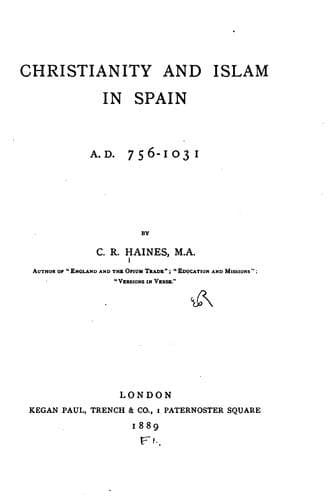
Christianity and Islam in Spain, A.D. 756-1031Haines, Charles Reginald
Islamic
Christianity and Islam in Spain, A.D. 756-1031
Haines, Charles Reginald
Christian martyrs -- Spain; Christianity -- Spain; Islam -- Spain
The second count[5] against the martyrs was that they had worked no
miracles--a serious deficiency in an age when miracles were almost the
test of sanctity. Eulogius[6] could only meet the charge by admitting
the fact, but adding that miracles were frequent in the early ages, in
order to establish Christianity on a firm basis; and that the constancy
of the martyrs was in itself a miracle (which was true, but not to the
point). Had he been content with this, he had done wisely; but he goes
on: "Moreover, miracles are no sign of truth, as even the unbelievers
can work them."[7] Now, by trying to show why these martyrs did not
perform any miracles, he admits by implication that they were deficient
in this particular;[8] and yet in other parts of his work he mentions
miracles performed by these very martyrs, as, for instance, by Isaac,
and by Flora, and Maria.[9] So that the worthy priest is placed in this
dilemma: If miracles are really no sign of truth, why attribute them to
the martyrs, when, as is allowed elsewhere, they were unable to work
them? if, on the other hand, they did perform these miracles, why not
adduce them in evidence against the detractors?
[1] Eul., "Mem. Sanct.," i. sec. 19.
[2] Isaiah v. 20.
[3] Eul., "Mem. Sanct.," i. sec. 24. Taken from some "Acts of
the Saints," probably those of SS. Emetherius and Caledonius--a
book obviously of no authority.
[4] "Ind. Lum.," sec. 10, "In hac Israelitica gente nullus
hactenus exstitit praedicator, per quod debitores fidei
tenerentur. Isti enim (_i.e._, the martyrs) apostolatus vicem
in eosdem et evangelicam praedicationem impleverunt, eosque
fidei debitores reddiderunt."
[5] Eul., "Mem. Sanct.," i. 13.
[6] "Lib. Apol.," sec 7.
[7] "Lib. Apol.," sec. 10.
[8] Cp. "Mem. Sanct.," i. sec. 13.
[9] "Mem. Sanct.," Pref., sec. 4.
The third objection is a curious one, that the martyrs were not put to
death by idolaters, but by men worshipping God and acknowledging a
divine law,[1] and therefore were not true martyrs. Eulogius misses the
true answer, which is obvious enough, and scornfully exclaims:--"As if
they could be said to believe in God, who persecute His Church, and deem
it hateful to believe in a Christ who was very God and very man."[2]
Fourthly, the martyrs died a quick and easy death. But, as Eulogius
points out,[3] pain and torture give no additional claim to the martyr's
crown.
Lastly, it was objected that the bodies of these martyrs, as indeed was
to be expected, corrupted, and were even, in some cases, devoured by
dogs. "What matter," says Eulogius,[4] "since their souls are borne away
to celestial mansions."
[1] Eul. "Lib. Apol.," sec. 3.
[2] _Ibid._, sec. 12.
[3] _Ibid._, sec. 5.
[4] "Mem. Sanct.," i. sec. 17.
Public-domain text, read in full here on John Shaqi.
Reviews
Reviews
No reviews yet
Be the first to share your thoughts on this work.
Elsewhere in the archive
Join the Discussion
Join the discussion
Sign in to leave a comment or review.
Sign InorCreate an account