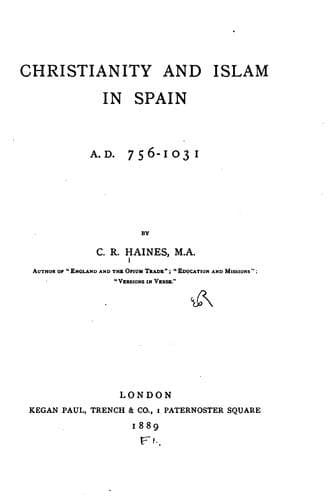
Christianity and Islam in Spain, A.D. 756-1031Haines, Charles Reginald
Islamic
Christianity and Islam in Spain, A.D. 756-1031
Haines, Charles Reginald
Christian martyrs -- Spain; Christianity -- Spain; Islam -- Spain
This was all the more opportune, as a chance was now given them of
returning to Barcelona, by joining the expedition which Mohammed I. was
on the point of making against Toledo. Orders had been given that all
the inhabitants, strangers as well as citizens, except the city guard,
should go out with the King. However, the Frankish monks were met by an
unexpected difficulty. In the temporary absence of the abbot, the monks
of Pegnamellar refused to give up the relics, and it was only with much
difficulty that the bishop Saul was induced to confirm his former
permission to remove them.
The bodies were now exhumed without the knowledge of the Moslems, and
sealed with Charles' own seal, brought for that purpose. George's body
was found whole, but of the other two, only the head of Nathalia, and
the trunk of Aurelius' body. The two latter are united to form one
corpse, as it is written, "they two shall be one flesh." After a stay in
Cordova of eight weeks, they set out under the protection of some
Christians serving in the army. Leovigild, who had been away on the
King's business, now returns, and escorts them to Toledo. The approach
of the army having cleared away the brigands who infested those parts,
the monks with their precious freight got safely away to Saragoza, and
returned with their booty to France, where the relics worked numbers of
astonishing miracles.
Let us return from this digression to the steps taken by the moderate
party among the Christians, and by the Moslem authorities, to put an end
to what seemed so dangerous an agitation. That Reccafredus was not the
only ecclesiastic of high position who took exception to the new
movement we learn clearly enough from Alvar,[1] who tells us that
"bishops, priests, deacons, and 'wise men' of Cordova joined in
inveighing against the new martyrdoms, under the impulse of fear
wellnigh denying the faith of Christ, if not in words, yet by their
acts." We may, therefore, conclude that the greater part of the
ecclesiastical authorities were heart and soul with the Bishop of
Seville, while the party led by Eulogius and Saul was a comparatively
small one. However, strong measures were necessary, and Reccafredus did
not hesitate to imprison several priests and clergy.[2] Eulogius
complains that the churches were deprived of their ministers, and the
customary church rites were in abeyance, "while the spider wove her web
in the deserted aisles, tenanted only by a dreadful silence." In this
passage the writer doubtless gives reins to his imagination, yet there
must have been a certain amount of truth in the main assertion, for he
repeats it again and again.[3]
Public-domain text, read in full here on John Shaqi.
Reviews
Reviews
No reviews yet
Be the first to share your thoughts on this work.
Elsewhere in the archive
Join the Discussion
Join the discussion
Sign in to leave a comment or review.
Sign InorCreate an account