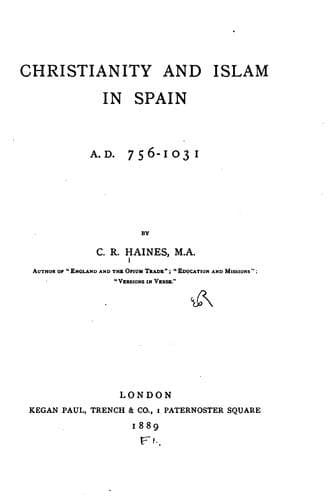
Christianity and Islam in Spain, A.D. 756-1031Haines, Charles Reginald
Islamic
Christianity and Islam in Spain, A.D. 756-1031
Haines, Charles Reginald
Christian martyrs -- Spain; Christianity -- Spain; Islam -- Spain
We will now turn back and take a general view of the Christian Church
and its condition under the Arabs in Spain, especially--for our
information is greatest as to those periods--under the two kings
Abdurrahman II. and III.
Under the former of these sovereigns the condition of the Christians,
until the persecution, which they themselves provoked, began, was very
tolerable, and the majority of the Christians were quite content with
their lot. They served in the army, both free men and slaves; they held
lucrative posts at Court, or in the houses of the Arab nobles, or as
government officials. But though the lay community was well off, the
clergy and stricter churchmen had something to complain of; for the
Church[5] could not be said to be free, though the worship was, since
the power of summoning councils had now passed to the Arab executive,
who, as we have seen, made even Moslems and Jews sit at these councils.
Sees were also put up to auction, and the scandalous spectacle was not
unknown, of atheists and heretics holding the titles, and drawing the
emoluments, of bishops.[6]
[1] Schott., iv. 246.
[2] Rohrbacher, xii. 192.
[3] Charter, apud Florez, xiv. 397.
[4] See above, p. 36, note 1. A letter also is mentioned of
John Servus Dei, Bishop of Toledo, to the Muzarabes with regard
to the late martyrdoms and apostasies, purporting to have been
written in 937.
[5] Dozy, ii. 47.
[6] Alvar, "Ep.," xiii. 3. Samson, "Apol.," ii. cc. ii.-iv.
As was to be expected, Arabic soon began to displace Latin throughout
the country, and even before the ninth century the Scriptures were
translated into the tongue of the conquerors [1] by Odoarius, Bishop of
Accita, and John of Seville. Hischem I. (788-796) forbade the use of any
language but Arabic, so that his Christian subjects had to use Arabic
Gospels;[2] and the Spaniards were soon not even permitted to write in
Latin.[3] Even if this statement be doubtful, we know that Latin came
gradually to be neglected and forgotten. Alvar utters an eloquent
protest against this: "Alas, the Christians are ignorant of their own
tongue, and Latins neglect their language, so that in all the College of
Christ[4] there is scarcely to be found one who can write an address of
welcome to his brother intelligibly in Latin, while numbers can be found
competent to mouth the flowery rhetoric of the Chaldeans."[5] In the
department of poetry--the peculiar boast of the Arabs--the Christians
seem even to have surpassed their masters; and to the rivalry of the two
nations in this art we may attribute the excellence and abundance of
native ballads of which Spain can boast.
Public-domain text, read in full here on John Shaqi.
Reviews
Reviews
No reviews yet
Be the first to share your thoughts on this work.
Elsewhere in the archive
Join the Discussion
Join the discussion
Sign in to leave a comment or review.
Sign InorCreate an account