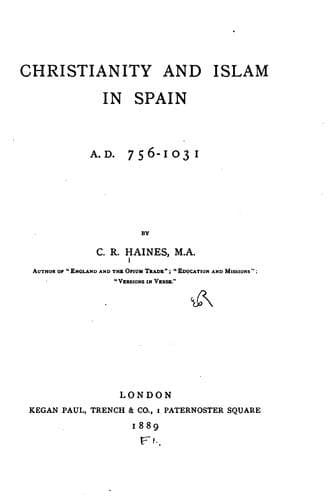
Christianity and Islam in Spain, A.D. 756-1031Haines, Charles Reginald
Islamic
Christianity and Islam in Spain, A.D. 756-1031
Haines, Charles Reginald
Christian martyrs -- Spain; Christianity -- Spain; Islam -- Spain
We find the abbot Samson distinctly accusing Hostegesis, Bishop of
Malaga, of simony, asserting that he sold the priesthood to low and
unworthy people;[1] while Alvar charges Saul, Bishop of Cordova, with
obtaining his bishopric by bribery.[2] Other irregularities imputed to
Hostegesis were that he held his see from his twentieth year, contrary
to the canons of the church, and that he beat priests, in order to
extort money from them, till they died under his hands.
Besides the election to the priesthood, by unworthy means, of unworthy
men, whose ignorance and impudence the congregation had to endure in
silence,[3] many were informally ordained without vouchers for character
being given, or the assent of their fellow-clergy and flocks being
obtained.[4] Many churches presented the unseemly spectacle of two rival
pastors, contrary to the ordinances received from the Fathers.[5]
Changes, too, were made in doctrine and ritual, for which no authority
could be alleged, in contravention of established custom and the
teaching of the Church. So far was this carried that Samson was accused
by his opponents of being a heretic and an idolator because he permitted
the marriage of cousins; dissented from the view that God was ever
enclosed in the chambers of the Virgin's heart;[6] asserted the
omnipresence of God, even in idols and the Devil, and this in an actual,
not a metaphysical, sense;[7] and denied that God sat upon an exalted
throne above his creatures. From this it is clear that Hostegesis and
those who thought with him[8] were infected with the anthropomorphite
heresy.
[1] Samson, "Apol.," Bk. ii., Pref. sec. 2.
[2] See "Letter to Saul," sec. 3--"Poterant enim quovis
asserente canonice incohationis vestrae primordia comprobari,
si quadringenti solidi non fuissent palam eunuchis vel aliis
exsoluti." Dozy, ii. 140, adds that the money was guaranteed on
the episcopal revenues, but this is a conjecture.
[3] Samson, "Apol.," ii. Pref. sec 5; Dozy, ii. 268.
[4] Alvar ad Saulum, sec. 3--"Sine testimonis, sine connibentia
clericorum."
[5] _Ibid._
[6] Samson, "Apol.," ii. Pref. sec. 7 and iii.--"Cubiculum
cordis Virginei." This appears to be a quotation from the
Gothic liturgy.
[7] "Per substantiam, non per subtilitatem."--_Ibid._
[8] Romanus and Sebastianus, Samson, Pref, sec. 6.
Public-domain text, read in full here on John Shaqi.
Reviews
Reviews
No reviews yet
Be the first to share your thoughts on this work.
Elsewhere in the archive
Join the Discussion
Join the discussion
Sign in to leave a comment or review.
Sign InorCreate an account