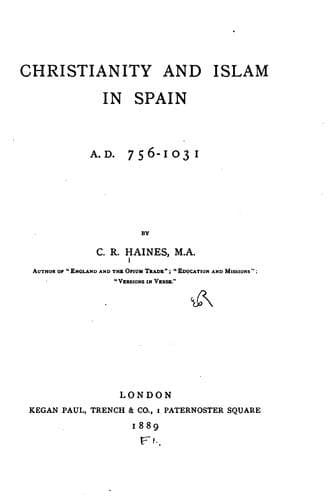
Christianity and Islam in Spain, A.D. 756-1031Haines, Charles Reginald
Islamic
Christianity and Islam in Spain, A.D. 756-1031
Haines, Charles Reginald
Christian martyrs -- Spain; Christianity -- Spain; Islam -- Spain
That the conversions from Christianity to Islam were very numerous at
first we can sufficiently gather from the fact that the new converts
formed a large and important party in the State, and almost succeeded in
wresting the government of Spain from the Arabs. The disorder and civil
war which may almost be said to have been chronic in Spain during the
Arab dominion were due to the fact that three distinct races settled in
that country were striving for the mastery, each of these races being
itself divided into two bitterly hostile factions. The Arabs were split
up into the two factions of Yemenite or Beladi Arabs, the descendants of
Kahtan, and Modharites, the Arabs of Mecca and Medina, who claimed
descent from Adnan.[1] To the latter section belonged the reigning
family of Umeyyades. The Berbers, who looked upon themselves as the real
conquerors of Spain, and whose numbers were subsequently reinforced by
fresh immigrations, were composed of two hostile tribes of Botar and
Beranis. Thirdly, there were the Spaniards, part Christian, part
Mohammedan; the latter being either renegades themselves or the
descendants of renegades. These apostates were called by the Arabs
Mosalimah, or New Moslems,[2] and their descendants Muwallads,[3] or
those not of Arabic origin. The Christians were either tribute-paying
Christians, called Ahlu dh dhimmah; or free Christians, under Moslem
supremacy, called Ajemi;[4] or apostates from Islam,[5] called
Muraddin. The Muwallads, in spite of the Mohammedan doctrine of the
equality and brotherhood of Moslems, were looked down upon with the
utmost contempt by the pure-blooded Arabs.[6] Their condition was even
worse than that of the Christians, for they were, generally speaking,
excluded from lucrative posts, and from all administration of affairs--a
dangerous policy, considering that they formed a majority of the
population.[7] Stronger and more humane than the Berbers, they were
friends of order and civilization. Intellectually they were even
superior to the conquering Arabs.[8]
The natural result of their being Spaniards by race, and Arabs by
religion, was that they sided now with one faction and now with another,
and at one time, under the weak Abdallah (888-912), were the mainstay of
the Sultan against his rebellious subjects. After breaking with the
Sultan they almost succeeded in gaining possession of the whole kingdom,
and carried fire and desolation to the very gates of Cordova.[9]
[1] See above, p. 23, note 3.
[2] Cp. "New Christians."
[3] Pronounced Mulads, hence Mulatto. The word means "adopted."
[4] Al Makkari, ii. 446. De Gayangos' note.
[5] Al Makkari, ii. 458.
[6] Cp. "Gordon in Central Africa," p. 300. "... the only
regret is that I am a Christian. Yet they would be the first to
despise me if I recanted and became a Mussulman." An Arab poet
calls them "sons of slaves," Dozy, ii. 258.
Public-domain text, read in full here on John Shaqi.
Reviews
Reviews
No reviews yet
Be the first to share your thoughts on this work.
Elsewhere in the archive
Join the Discussion
Join the discussion
Sign in to leave a comment or review.
Sign InorCreate an account