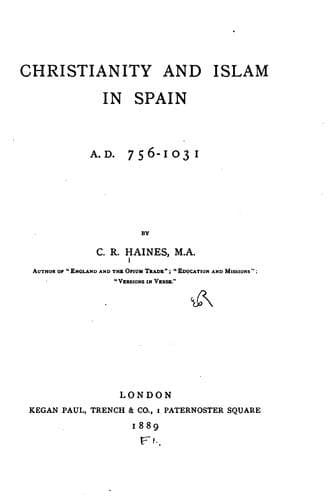
Christianity and Islam in Spain, A.D. 756-1031Haines, Charles Reginald
Islamic
Christianity and Islam in Spain, A.D. 756-1031
Haines, Charles Reginald
Christian martyrs -- Spain; Christianity -- Spain; Islam -- Spain
slaves? It is not ambition that prompts me to rebel, but a desire to
avenge you and myself." To strengthen his cause he made alliances at
different times with the Muwallads in Elvira, Seville, and Saragoza,
and with the successful rebel, Abdurrahman ibn Merwan, in Badajos.
[1] Dozy, ii. 190.
[2] Al Makkari, ii. 437. De Gayangos' note.
[3] In 880 or 881.
[4] See a description of him quoted by Stanley Lane-Poole
("Moors in Spain," p. 107) from an Arab writer: "Woe unto thee,
Cordova! when the captain with the great nose and ugly face--he
who is guarded before by Moslems, and behind by idolaters--when
Ibn Hafsun comes before thy gates. Then will thine awful fate
be accomplished."
Openly defying the Sultan's forces, he was only kept in check by
Almundhir, the king's son, who succeeded his father in 886. Omar was
further strengthened by the accession to his side of Sherbil, the Count
of Cordova.[1] The death of Almundhir in 888 removed from Omar's path
his only able enemy, and, during Abdallah's weak reign, the rebel leader
was virtual king of the south and east of Spain. The district of
Regio[2] was made over to him by the king, and Omar's lieutenant, Ibn
Mastarna, was made chief of Priejo.
This protracted war, which was really one for national independence, was
carried on year after year with varying success. At one time Omar
conceived the intention of proclaiming the Abasside Khalifs,[3] at
another he grasped at the royal power himself; and Abdallah's empire was
only saved by a seasonable victory in 891 at Hisn Belay (or Espiel).[4]
The battle was fought on the eve of the Passover, and the Moslems
taunted their enemies with having such a joyful feast, and so many
victims to commemorate it with. This shows that a large, perhaps the
largest, part of Omar's army was Christian. Another indication of this
is found in a poem of Tarikh ibn Habib,[5] where, speaking of the coming
destruction of Cordova, he says: "The safest place will then be the hill
of Abu Abdu, where once stood a church," meaning that Omar's Christian
soldiers would respect that sanctuary, and no other. Indeed, it is
certain that Omar himself became a Christian some time before this
battle,[6] as his father had done before him. He took the name of
Samuel, and his daughter Argentea, as we have seen, suffered martyrdom.
This change of creed on Omar's part changed the character of the war,
and gave it more of a religious,[7] and perhaps less of a national,
character, for the Spanish Moslems fell off from him, when he became
Christian and built churches.
[1] Servandus. Al Makkari, ii. 456. De Gayangos' note.
[2] Where Islam was almost extinct. Dozy, ii. 335.
[3] Al Makkari, ii. p. 456. De Gayangos' note.
[4] Ibn Hayyan, apud Al Makk., ii. p. 452. This seems to be the
same victory as that which Dozy (ii. 284) calls Polei or
Aguilar.
[5] See Dozy, ii. p. 275.
[6] Ibn Hayyan, apud Dozy, ii. p. 326.
Public-domain text, read in full here on John Shaqi.
Reviews
Reviews
No reviews yet
Be the first to share your thoughts on this work.
Elsewhere in the archive
Join the Discussion
Join the discussion
Sign in to leave a comment or review.
Sign InorCreate an account