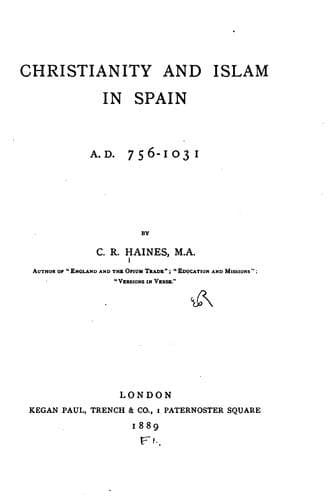
Christianity and Islam in Spain, A.D. 756-1031Haines, Charles Reginald
Islamic
Christianity and Islam in Spain, A.D. 756-1031
Haines, Charles Reginald
Christian martyrs -- Spain; Christianity -- Spain; Islam -- Spain
Another extract from an Arabic writer will show us what the Moslems
thought of the worship of St James, the patron saint of Spain, round
whose shrine rallied the religious revival in the north of the
Peninsula. It is Ibn Hayyan,[2] who, in his account of Almanzor's
fiftieth expedition against the Christians, says:--"Shant Yakoh
(Santiago)[3] is one of the sanctuaries most frequented, not only by the
Christians of Andalus, but of the neighbouring continent, who look upon
its church with a veneration such as Moslems entertain for the Caaba of
Mecca; for their Caaba is a colossal idol (statue) which stands in the
middle of the church. They swear by it, and repair to it in pilgrimage
from the most distant parts, from Rome, as well as other countries
beyond Rome, pretending that the tomb to be seen in the church is that
of Yakob (James), one of the twelve apostles, and the most beloved by
Isa (Jesus).--May the blessing of God be on him, and on our
Prophet!--The Christians call this Yakob the brother of Jesus, because,
while he lived, he was always with him. They say that he was Bishop of
Jerusalem, and that he wandered over the earth preaching the religion
[of Christ], and calling upon the inhabitants to embrace it, till he
came to that remote corner of Andalus; that he then returned to Syria,
where he died at the age of 120 solar years. They pretend likewise that,
after the death of Yakob, his disciples carried his body and buried it
in that church, as the most remote part, where he had left traces [of
his preaching]."
[1] II. 227, apud Dozy, iii. 342. Ibn Hazm was, says Dozy, "a
strict Moslem, _averse to judging divine questions by human
reasoning_."
[2] Al Makkari, ii. 293.
[3] Miss Yonge, p. 87, says the Arabs called him Sham Yakub,
but what authority has this statement?
In a country where literature and the arts were so keenly cultivated, as
they were in Spain during the time of Arab domination, and where the
rivalry of Christian, Jew, and Moslem produced a sustained period of
intellectual activity such as the world has rarely seen, controversial
theology could not fail to have been largely developed. But the books,
if any were written, from the Christian or Moslem standpoint, have all
perished, and we have only such slight and unsatisfactory notices left
to us as those already quoted.
Public-domain text, read in full here on John Shaqi.
Reviews
Reviews
No reviews yet
Be the first to share your thoughts on this work.
Elsewhere in the archive
Join the Discussion
Join the discussion
Sign in to leave a comment or review.
Sign InorCreate an account