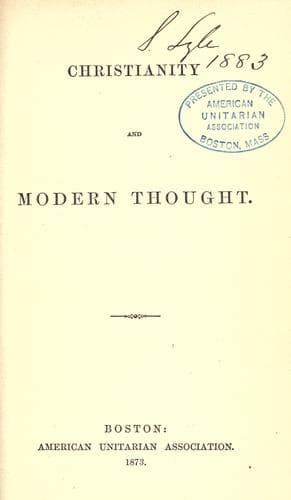
Christianity and Modern ThoughtPeabody, Andrew P. (Andrew Preston)
Religion
Christianity and Modern Thought
Peabody, Andrew P. (Andrew Preston)
Unitarianism
A naturalist who to his own satisfaction has traced the pedigree of the
human intellect, conscience, and religion, to Ascidian skin-bags
sticking to the sea-side rocks, is not likely to arrest the genealogy
there, at a stage so little fitted to serve as a starting-point of
derivative being. Or, if his own retreat should go no further, others
will take up the regressive race, and, soon passing the near and easy
line into the vegetable kingdom, will work through its provinces to its
lichen-spotted edge: and, after perhaps one shrinking look, will dare
the leap into the dead realm beyond, and bring home the parentage of all
to the primitive elements of "matter and force." To give effect to this
extension over the universe at large of the theory of Evolution, the
scientific imagination of our day has long been meditating its projected
book of Genesis, and has already thrown out its special chapters here
and there; and though the scenes of the drama as a whole are not yet
arranged, the general plan is clear: that the Lucretian method is the
true one; that nothing arises for a purpose, but only from a power; that
no Divine Actor therefore is required, but only atoms extended,
resisting, shaped, with spheres of mutual attraction and repulsion;
that, with these _minima_ to begin with, a growth will follow of itself
by which the _maxima_ will be reached; and that thus far the chief and
latest thing it has done is the apparition of Mind in the human race and
civilization in human society, conferring upon man the melancholy
privilege of being, so far as he knows, at the summit of the universe.
The main support of this doctrine is found in two arguments, supplied
respectively by physical science and by natural history; each of which
we will pass under review.
Public-domain text, read in full here on John Shaqi.
Reviews
Reviews
No reviews yet
Be the first to share your thoughts on this work.
Elsewhere in the archive
Join the Discussion
Join the discussion
Sign in to leave a comment or review.
Sign InorCreate an account