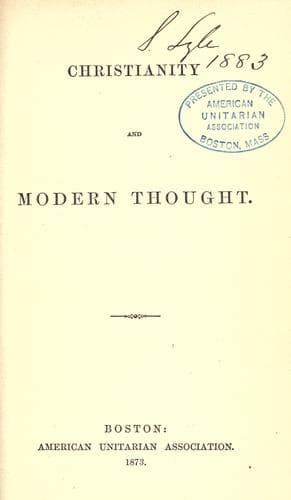
Christianity and Modern ThoughtPeabody, Andrew P. (Andrew Preston)
Religion
Christianity and Modern Thought
Peabody, Andrew P. (Andrew Preston)
Unitarianism
and the variable states of magnetism and heat, which throw the
combinations into slow though constant change. But with all your
enlargement of data, turn them as you will, at the end of every passage
which they explore, the _door of life_ is closed against them still; and
though more than once it has been proclaimed that a way has been found
through, it has proved that the living thing was on the wrong side to
begin with. It is not true, therefore, that, from the two earlier stages
of force, the ascent can be made to the vital level; the ethereal fire
yet remains in Heaven; and philosophy has not stretched forth the
Promethean arm that can bring it down. And if, once more, we make you a
present of this third phase of power, and place at your disposal all
that is contained beneath and within the flora of the world, still your
problem is no easier than before; you cannot take a single step towards
the deduction of sensation and thought: neither at the upper limit do
the highest plants (the exogens) transcend themselves and overbalance
into animal existence; nor at the lower, grope as you may among the
sea-weeds and sponges, can you persuade the sporules of the one to
develop into the other. It is again not true, therefore, that, in virtue
of the convertibility of force, the possession of any is the possession
of the whole: we give you all the forms but one; and that one looks
calmly down on your busy evolutions, and remains inaccessible. Is, then,
the transmigration of forces altogether an illusion? By no means; but
before one can exchange with another, _both must be there_; and to turn
their equivalence into a universal formula, _all_ must be there. With
only one kind of elementary matter, there can be no chemistry; with
only the chemical elements and their laws, no life; with only vital
resources, as in the vegetable world, no beginning of mind. But let
Thought and Will with their conditions once be there, and they will
appropriate vital power; as life, once in possession, will ply the
alembics and the test-tubes of its organic laboratory; and chemical
affinity is no sooner on the field than it plays its game among the
cohesions of simple gravitation. Hence it is impossible to work the
theory of Evolution upwards from the bottom. If all force is to be
conceived as One, its type must be looked for in the highest and
all-comprehending term; and Mind must be conceived as there, and as
divesting itself of some specialty at each step of its descent to a
lower stratum of law, till represented at the base under the guise of
simple Dynamics. Or, if you retain the forces in their plurality, then
you must _assume_ them _all_ among your data, and confess, with one of
the greatest living expositors of the phenomena of Development, that
unless among your primordial elements you scatter already the germs of
mind as well as the inferior elements, the Evolution can never be
wrought out.[15] But surely a theory, which is content simply to assume
Public-domain text, read in full here on John Shaqi.
Reviews
Reviews
No reviews yet
Be the first to share your thoughts on this work.
Elsewhere in the archive
Join the Discussion
Join the discussion
Sign in to leave a comment or review.
Sign InorCreate an account