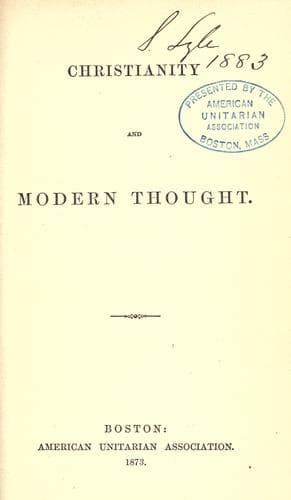
Christianity and Modern ThoughtPeabody, Andrew P. (Andrew Preston)
Religion
Christianity and Modern Thought
Peabody, Andrew P. (Andrew Preston)
Unitarianism
There is profound truth in this legend. It indicates at once the mental
receptivity and the moral inability of man, as to mere precepts of
virtue. It is not enough that we know the right. We know much better
than we do. The words which Ovid puts into the mouth of Medea, _Video
meliora, proboque, deteriora sequor_ ("I see and approve the better, I
pursue the worse"), are the formula of universal experience. We, most of
all, need enabling power. This we have through Christianity alone. We
have it: 1. In the Divine fatherhood, as exhibited in those genial,
winning traits, in which Jesus verifies his saying, "He that hath seen
me hath seen the Father,"--a fatherhood to feel which is to render glad
and loving obedience to the Father's will and word; 2. In the adaptation
of the love, sacrifice, and death of Christ to awaken the whole power of
loving in the heart, and thus by the most cogent of motives to urge man
to live no longer for himself, but for him who died for him; 3. In the
assurance of forgiveness for past wrongs and omissions, without which
there could be little courage for future well-doing; 4. In the promise
and realization of Divine aid in every right purpose and worthy
endeavor; 5. In institutions and observances designed and adapted to
perpetuate the memory of the salient facts, and to renew at frequent
intervals the recognition of the essential truths, which give to our
religion its name, character, and efficacy.
* * * * *
Thus, while right and obligation exist independently of revelation, and
even of natural religion, Christianity alone enables us to discern the
right in its entireness and its due proportions; and it alone supplies
the strength which we need, to make and keep us true to our obligations,
under the stress of appetite and passion, cupidity and selfishness,
human fear and favor.
Morality and religion, potentially separable, are yet inseparable in the
will of God, under the culture of Christ. It used to be common to place
the legal and the evangelical element in mutual antagonism. Nothing can
be more profane or absurd than this. That which is not legal is
evangelical only in name and pretence. That which is not evangelical is
legal to no purpose. The religious belief or teaching, which lays not
supreme stress on the whole moral law, is an outrage on the Gospel and
the Saviour. The morality, which rests on any other foundation than
Jesus Christ and his religion, is built on the sand, the prey of the
first onrush or inrush of wind or wave. "What therefore God hath joined
together, let not man put asunder."
CHRISTIANITY:
WHAT IT IS NOT, AND WHAT IT IS.
By G. VANCE SMITH.
I.
Public-domain text, read in full here on John Shaqi.
Reviews
Reviews
No reviews yet
Be the first to share your thoughts on this work.
Elsewhere in the archive
Join the Discussion
Join the discussion
Sign in to leave a comment or review.
Sign InorCreate an account