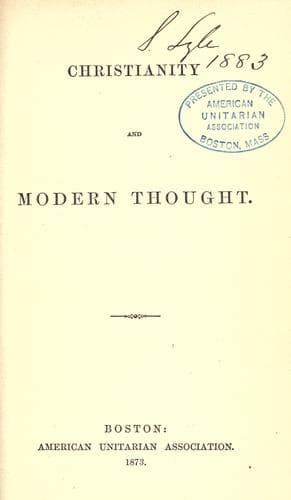
Christianity and Modern ThoughtPeabody, Andrew P. (Andrew Preston)
Religion
Christianity and Modern Thought
Peabody, Andrew P. (Andrew Preston)
Unitarianism
But, whatever the hindrances of this kind in the way of a perfectly just
estimation by the modern disciple, the portrait of Christ preserved for
us by the Evangelists is, in a remarkable degree, that of a great
Religious Character. The Christ of the Gospels is, before all things, a
Spiritual Being, unpossessed, it may even be said, of the personal
qualities which might mark him off as the product of a particular age or
people. He is, in large measure, the opposite of what the disciples were
themselves, free from the feelings and prejudices of his Jewish birth
and religion. This he evidently is, without any express design of
theirs, and by the mere force of his own individuality. He is thus, in
effect, the Christ[22] not merely of his immediate adherents, or his own
nation, but of all devout men for all ages. He stands before us, in
short, so wise, and just, and elevated in his teaching, so upright and
pure in the spirit of his life, so engaging in his own more positive
example of submission to the overruling will, and touching forbearance
towards sinful men, that innumerable generations of disciples, since his
death, have been drawn to him and led to look up to him even as their
best and highest human representative of the Invisible God Himself.
[Footnote 22: That is to say, "anointed," or _King_,--in other words,
Leader, Teacher, Saviour from sin, as the Gospels also expressly term
him.]
It is very probable, however, that all this was not so fully seen by
those who stood nearest to Jesus during his brief and rapid career, as
it has been since. At least many, even the vast majority of his day,
failed to perceive it. And yet, to a Hebrew reader of the Gospels, the
greatness of his character could be summed up in no more expressive
terms than by claiming for him that he was the Christ; that he embodied
in himself the moral and intellectual pre-eminence associated with that
office. In this light he is especially represented in the first three
Gospels. In John, too, we have substantially the same thing, though very
differently expressed. In that Gospel, he is also the Christ, but he is
so by the indwelling of the divine Word. "The Word became flesh and
dwelt among us," and the glory which had been seen among men, "full of
grace and truth," was the glory even "as of the only-begotten of the
Father." Probably no language could have been used that would have
conveyed to a reader of the time a higher idea of the moral and
spiritual qualities of any human being. And this corresponds entirely
with the impression given by other writers of the New Testament, to some
of whom Jesus was personally known,--by Peter, for example, by James, by
Paul, and by the writer to the Hebrews. They evidently looked back to
their departed Master, and up to the risen Christ, as a person of
commanding dignity and spiritual power, and this not merely on account
of the official title of Messiah which, rightly or wrongly, they applied
Public-domain text, read in full here on John Shaqi.
Reviews
Reviews
No reviews yet
Be the first to share your thoughts on this work.
Elsewhere in the archive
Join the Discussion
Join the discussion
Sign in to leave a comment or review.
Sign InorCreate an account