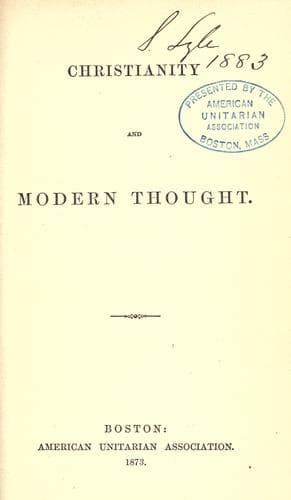
Christianity and Modern ThoughtPeabody, Andrew P. (Andrew Preston)
Religion
Christianity and Modern Thought
Peabody, Andrew P. (Andrew Preston)
Unitarianism
But, on the other hand, if this be true, one who may thus think need not
of necessity also hold that the miracles of the Gospels did not take
place, but that the history relating to them is the mere product of weak
and credulous exaggeration. For, in truth, the ends which might be
subserved by such manifestations are easily understood. Occurrences so
unwonted and remarkable could not fail both to secure the attention of
the spectator, and make him ponder well upon the words of the
miracle-worker, and also to awaken in him new feelings of reverence
towards the mysterious Being who had given such power to men. Thus it is
readily conceivable, that a miracle might be a thing of the highest
utility to those who witnessed it and to their generation. But then, on
the other hand, it is not to be alleged that such occurrences are needed
now to show us that God is a living Spirit in the world; or,
consequently, that religious love and veneration are in any way
dependent upon them, either as facts beheld by ourselves, or as
incidents recorded to have been seen by others who lived many centuries
ago. And, if this be so, surely we may look with indifference upon the
most destructive operations of literary or scientific criticism, being
anxious only, and above all things, for the simple truth, whatever it
may be.
Again, however, it is not to be denied that the possession of miraculous
power may have been for Christ himself, not less than for those who saw
his works, of the deepest spiritual import. The formation of a character
like his would seem peculiarly to require the training that would be
afforded by such an endowment. We know how, with ordinary men, the
command of unlimited power is, in fact, a test of rectitude,
self-government, unselfishness, of the most trying and, it may be, most
elevating, kind. The temptations which necessarily accompany it are
proverbial. Was Christ exempt from that kind of moral discipline, that
supreme proof of fidelity to God? Allowing, for a moment, what the
narratives directly intimate, that he felt within himself the force of
miraculous gifts, and the capacity to use them, if he had so willed, for
purposes either of personal safety or of political ambition;[25] in
this, we may see at once, there would be an end to be served of the
greatest moment both to himself and to the future instruction of his
disciples. By such an experience, the moral greatness of his example
might be doubly assured. It would be made possible to him to deny and
humble himself,--even, in apostolical phrase, to "empty" himself of his
Messianic prerogatives, in order the better to do the Heavenly Father's
will, and, preferring even the cross to a disobedient refusal of the cup
which could not pass from him, to be "made perfect through suffering,"
thus showing himself worthy to be raised up at last to be, as he has
been, the spiritual Lord of the Church.
[Footnote 25: Matt. iv. 1, seq.]
Public-domain text, read in full here on John Shaqi.
Reviews
Reviews
No reviews yet
Be the first to share your thoughts on this work.
Elsewhere in the archive
Join the Discussion
Join the discussion
Sign in to leave a comment or review.
Sign InorCreate an account