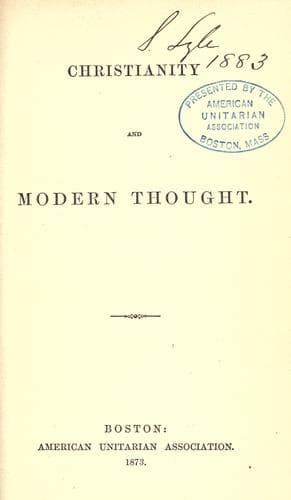
Christianity and Modern ThoughtPeabody, Andrew P. (Andrew Preston)
Religion
Christianity and Modern Thought
Peabody, Andrew P. (Andrew Preston)
Unitarianism
[Footnote 28: A good authority has recently observed, "Catholicism,
substituted for Christ, has turned the thought of Southern Europe to
simple Infidelity, if not to Atheism; let us take heed that
Protestantism does not bring about the same thing in another way in the
North."--Bishop Ewing, in a _Letter_ to the Spectator newspaper, April
8, 1870. The remark here quoted is of much wider application than the
Bishop himself would probably admit!]
The experience of past ages, the existing sectarian divisions of
Christendom, the errors and superstitions involved in the grosser
assumptions of Church authority, all unite to compel us to the
conclusion of the essentially erroneous character of the old ritualistic
and dogmatic conceptions of the nature of the Gospel. They show us not
only that dogmas and rites about which the most earnest men are so
utterly at variance cannot possibly be of the essence of Christianity,
but further that the latter is nowhere to be found except in Him whom in
spite of diversities all alike agree to hold in honor. And, in truth,
his life, brief and fleeting as it was, may well be said to constitute
the Christian revelation. That it does so, and was intended to do so,
may, as already observed, be seen better in our day, than it was by the
earliest disciples. Their thoughts were preoccupied, their vision
obscured, by various influences which prevented them from clearly
discerning the one thing needful. The temporal kingdom of their Master
for which they were, many of them, so eagerly looking; his speedy return
to judge the world,--an expectation of which there are so many traces in
Gospels and Epistles alike; the great and urgent question of the Law and
its claims, with that of the admission of the Gentiles to the faith of
Christ without the previous adoption of Judaism;--such thoughts and such
cares as these largely engaged and filled the minds of the disciples,
within the limits of the period to which the origin of the principal New
Testament books must be assigned. After the close of that period, fresh
subjects of controversial interest continually arose, until these were
gradually overshadowed by the rising authority of the Church and the
later growth of sacerdotal power, followed in due course of time by the
grosser corruptions of the primitive Gospel which marked the
Christianity of the darker ages, and which have by no means as yet spent
their power. Thus has it pleased the Great Disposer that men should be
led forward to truth and light through error and darkness. Even as the
Hebrews of old were gradually brought by many centuries of experience,
and in the midst of imperfections and backslidings innumerable, to their
final recognition of the One Jehovah, so have the Christian generations
been slowly learning and unlearning according as their own condition and
capacities allowed. Thus the great development has been running its
destined course, and will doubtless conduct us eventually to yet better
Public-domain text, read in full here on John Shaqi.
Reviews
Reviews
No reviews yet
Be the first to share your thoughts on this work.
Elsewhere in the archive
Join the Discussion
Join the discussion
Sign in to leave a comment or review.
Sign InorCreate an account