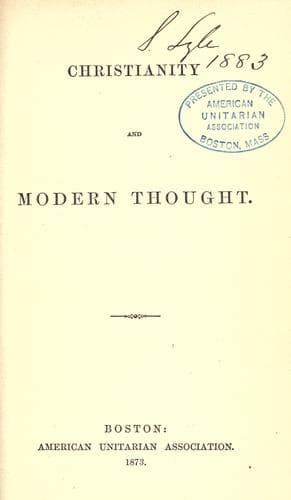
Christianity and Modern ThoughtPeabody, Andrew P. (Andrew Preston)
Religion
Christianity and Modern Thought
Peabody, Andrew P. (Andrew Preston)
Unitarianism
In all his Epistles St. Paul, in the true spirit of his Master, gives us
clearly to know what is of chief importance. After treating, as he
usually does, of the local and passing concerns and disputes which
engaged many of his correspondents, he never fails to turn at last to
speak of the practical goodness, the purity of heart and life, the
kindly affections towards one another, the reasonable service of love
and duty, by which the Christian disciple may be known, by which alone
he can present himself as a "living sacrifice, holy, acceptable unto
God." In such qualities as these, the attainment or the practice of
which he so earnestly urges upon his friends, we have precisely what
constitute the most marked features in the life and the teachings of
Christ. Thus we are brought once more to the old conclusion that in
faithful loyalty to Christ, to the highest ideal presented to us of his
spirit and character, are to be found the true light and joy and peace
of the Christian Gospel.
A third objection is of a different character. There are some things, it
will be said, in immediate connection with him whom we term Teacher and
Lord, some things in his words and ideas, if not in his actions, which
are far from being in perfect harmony with the highest truth, as known
to men in these later times. For example, when he speaks as though he
believed diseases and insanity to be caused by the presence of a devil,
or demon, in the afflicted person, are we to attach importance to this,
so as ourselves to think that such disorders are (or were) so
produced?--or shall we not rather follow the guidance of modern science,
and believe that the various infirmities which, in ancient times, were
attributed to evil spirits arose from natural causes, and that the
manner in which such things are spoken of in the New Testament is a
product simply of the imperfect knowledge of those days?
In reply, there need be no hesitation in saying that we are bound, as
beings of thought and reason, to follow the best guidance which God has
given us, in these and all other subjects; and by the term _best_ can
only be understood that which commends itself most forcibly to our
rational intelligence. It can in no way be claimed for Christ that he
was intellectually perfect; that he did not share in the prevailing
beliefs of his countrymen, and partake even of their ignorance. Such a
claim as this is certainly nowhere advanced in the New Testament, but
the _contrary_; and those who, in our time, would bring it forward
should ask themselves whether, by so doing, they are most likely to
benefit, or to injure, the cause which doubtless they would desire to
support. Jesus himself makes no pretension to intellectual
infallibility, but lets us see, in no uncertain way, that he was not
unconscious of the limitation of his own knowledge.[30]
[Footnote 30: Mark xiii. 32.]
Public-domain text, read in full here on John Shaqi.
Reviews
Reviews
No reviews yet
Be the first to share your thoughts on this work.
Elsewhere in the archive
Join the Discussion
Join the discussion
Sign in to leave a comment or review.
Sign InorCreate an account