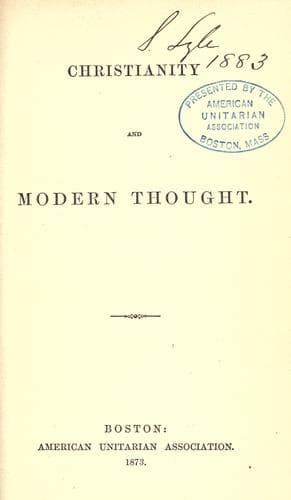
Christianity and Modern ThoughtPeabody, Andrew P. (Andrew Preston)
Religion
Christianity and Modern Thought
Peabody, Andrew P. (Andrew Preston)
Unitarianism
So long as Christianity shall be thus capable of speaking to the world,
so long will it, amidst all the varieties of outward profession, be a
living power for good; and vain will be the representation which would
tell us that it is now only a thing of the past, unfitted for the better
knowledge and higher philosophy of these modern times. Surely not
so!--but, rather, until we have each individually attained the moral
elevation even of Christ himself, and can say that we too, in character
and conduct, in motive and aspiration, are well pleasing in the sight of
Heaven, until we _are_ this, and can feel and say this with truth, the
religion of Christ will be no antiquated thing of the past to _us_; but
from its teaching and its spirit--the teaching and the spirit of
Christ--we shall still have wisdom and truth to learn.
May the time speedily come, which shall see Christ's spirit ruling the
individual lives of all around us,--more truly inspiring the thoughts
and efforts of our lawgivers,--teaching men everywhere to be just and
merciful towards each other; and thus making Christianity, in deed and
in truth, the "established religion," the guiding and triumphant power
of this and all other lands! Then, indeed, will the daily prayer of all
Christian hearts be answered, and the "kingdom of heaven" on earth be
truly come.
THE AIM AND HOPE OF JESUS.
By OLIVER STEARNS.
A learned Historian of the Christian Theology of the Apostolic age
observes that what most distinguishes the Jewish religion, at least in
its last centuries, is not so much monotheism as faith in the future.
While elsewhere we see the imagination of men complacently retracing the
picture of a golden age irrecoverably lost, Israel, guided by its
prophets, persisted in turning its eyes towards the future, and attached
itself the more firmly to a felicity yet to come, the more the actual
situation seemed to give the lie to its hopes.[32]
[Footnote 32: Reuss, History of the Christian Theology of the Apostolic
Age.]
What these hopes were in relation to the future of that people and of
the world, what the Messianic ideas and expectations were, we learn from
the New Testament, particularly from the Gospels. And we find our
impressions from this source made more clear in some points, and in all
confirmed, by a study of the Apocalyptic literature,--of those writings
of which it was the object to give both shape and expression to the
Hebrew thought of the kingdom of heaven, and of the brilliant and
miraculous events which would introduce and establish it.
Public-domain text, read in full here on John Shaqi.
Reviews
Reviews
No reviews yet
Be the first to share your thoughts on this work.
Elsewhere in the archive
Join the Discussion
Join the discussion
Sign in to leave a comment or review.
Sign InorCreate an account