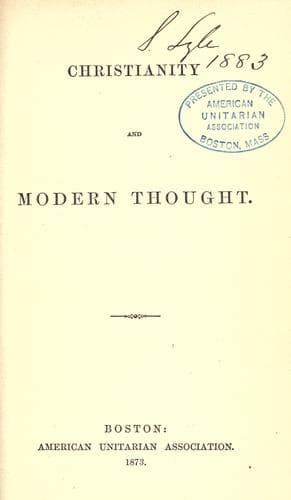
Christianity and Modern ThoughtPeabody, Andrew P. (Andrew Preston)
Religion
Christianity and Modern Thought
Peabody, Andrew P. (Andrew Preston)
Unitarianism
Into the circle of these ideas and expectations Jesus was born. In it he
passed his life, acted and suffered; and claimed to found the kingdom of
God. He claimed in some sense to be the Messiah; and, though rejected by
his people and put to death, he has borne the name in history, and now
bears it. He is Jesus, the Christ. How did he regard these ideas and
expectations? Did he adopt them? And, if at all, how far? Did he claim
to be such a Messiah as the Jews expected? If so, then Christianity may
be what it has been called, "a natural development of Judaism." It is
not essentially a new religion. It is not an evolution of a perfect
universal, from an imperfect and partial, religion. It is essentially
Judaism still; and "the kingdom of God, which Jesus preached in both a
temporal and spiritual sense, developed naturally and logically into the
Popedom, which is the nearest approximation to the fulfilment of the
claim of Jesus. Judaism is germinal Christianity, and Christianity is
fructified Judaism." Christianity is only what is weakest and most
fantastic in Judaism gone to seed. _The fruit_ is the Roman Hierarchy
and Ritual. That which is alone characteristic of it is limited and
perishable. Jesus himself, though his ambition was a lofty one, was
mistaken in an essential point of his self-assertion; and the gospel is
not destined to be an universal religion, but only to make some moderate
contributions thereto.
It is an important question, then,--one which concerns his worth and
position as a man, as well as his wisdom as a founder of a
religion,--What did Jesus aim at? and what did he expect as the result
of his movement? The answers that have been given may be reduced to
three principal forms: 1. He expected to found a political Empire; 2. He
expected to introduce a vast Theocracy, to which believers of other
nations should be admitted, and which was to be established on the
renovated earth, after his death, at his return to take possession of it
as King, to reward his followers, and to put all opposition under his
feet; 3. He expected to found a purely spiritual communion or society in
which he should continue to exercise for ages, by his spirit, word, and
life, a power of truth and love over the minds and hearts of men,
filling them with the most exalted sense of God.
Public-domain text, read in full here on John Shaqi.
Reviews
Reviews
No reviews yet
Be the first to share your thoughts on this work.
Elsewhere in the archive
Join the Discussion
Join the discussion
Sign in to leave a comment or review.
Sign InorCreate an account