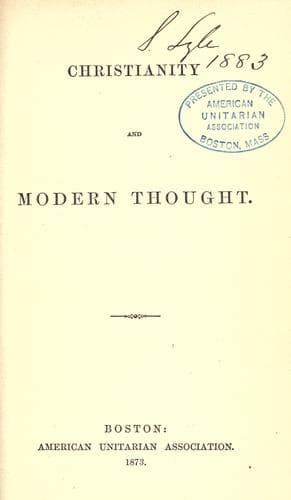
Christianity and Modern ThoughtPeabody, Andrew P. (Andrew Preston)
Religion
Christianity and Modern Thought
Peabody, Andrew P. (Andrew Preston)
Unitarianism
The movement of Jesus, then, may be called revolutionary, not in the
sense of aiming directly at political revolution, but in the sense of
his expecting to found a free, spiritual, and universal religion, which
would uproot and remove in time the partial religions, Judaism included.
Still he designed to connect himself with the Old Dispensation. He
recognized the Divine mission of Moses and the Providential office of
the prophets in preparing for him. In the expectations which they
fostered there was something true as well as something false. When they
depicted a glorious and happy political condition of the Jewish nation
under the Messiah as an earthly king, Jesus must have regarded them as
being in error. We find him pronouncing John the Baptist the greatest of
the prophets of the old order, and declaring that the least in the
kingdom of heaven was greater than he; and the reason is shown by the
context of the words (Matt. xi.) to be that John as a Jewish prophet
regarded the kingdom of God in part as a political kingdom. But the
fundamental idea of the Theocracy, that other nations would be united
with Israel under the dominion of the One True God, was one in harmony
with Jesus' thought.[34] This expectation Jesus regarded it as his
mission to realize and fulfil. He had only to separate from the
Theocratic predictions of the prophets the partial political element, to
bring them into unison with his universal aim. Whatever in the hitherto
prevailing ideas and hopes was capable of expansion he absorbed into
himself, that it might be given out in a wider and higher form, and
live for ever. A case somewhat parallel might be found in the changes
wrought by our late war. Those who took a radical view of the issue of
the contest were exposed to the charge of being revolutionary and
destroying the Constitution. They could reply, "Yes: the issue will be
revolutionary. There will be a new state of law, and of the relations of
the people in important respects, effected by carrying out fundamental
principles. But those principles were the essence of the Constitution;
and to carry them out is only fully to accomplish its purpose, by
annihilating transient provisions at war with liberty and social
justice, and giving scope to the principles of the Declaration of
Independence. We hold to the Constitution. We have come not to destroy,
but to fulfil." So Jesus Christ came not to destroy all that had gone
before, but to fulfil whatever in it was fundamental to the Divine
purpose in relation to man. In this feeling of a real connection between
his movement and the Hebrew ideas and hopes is to be found the principal
explanation of his confining his labors, and those of the apostles when
first sent forth, chiefly to Judea and Galilee. Not only must his own
work be limited in its local scope,--for he could not go
everywhere,--but the historical basis of his movement lay in the Hebrew
history. Among the Hebrew people only could he find suitably prepared
Public-domain text, read in full here on John Shaqi.
Reviews
Reviews
No reviews yet
Be the first to share your thoughts on this work.
Elsewhere in the archive
Join the Discussion
Join the discussion
Sign in to leave a comment or review.
Sign InorCreate an account