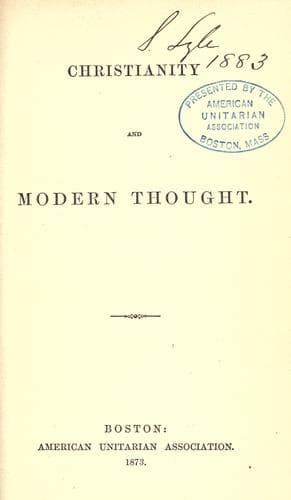
Christianity and Modern ThoughtPeabody, Andrew P. (Andrew Preston)
Religion
Christianity and Modern Thought
Peabody, Andrew P. (Andrew Preston)
Unitarianism
The result of our inquiries is, that Jesus did not aim at any political
sovereignty, that he rose by the force of the special endowment of his
nature above the Apocalyptic superstition of his age, and that he looked
and labored immediately for the moral and spiritual renovation of
humanity on this earth. He claimed to be a Messiah; not a Messiah after
the Jewish conceptions, but a man anointed and endowed of God, to
perfect by the manifestation of the Divine in the human, the means of
this moral renovation of humanity. He regarded the spiritual Messiahship
as a divinely appointed means to this end. He aspired to spiritual rule
for no end but this, and his aspiration was disinterested, godlike. It
has been said that he was ambitious, though it is allowed that his
ambition was the most elevated. And he has been compared with
disadvantage to Socrates, whose ambition, it is said, was "_to serve
without reigning_," while that of Jesus was "_to reign by serving_," and
the former is justly thought to be the nobler purpose. It is no time to
institute a comparison between Jesus and Socrates. I have no wish to
disparage the great Pagan. I will allow Grote's estimate, that the
Apology as given by Plato is the speech of one who deliberately foregoes
the immediate purpose of a defence, the persuasion of his judges; who
speaks for posterity without regard to his own life. The aim of Socrates
was disinterested, but not so elevated as that of Jesus. The aim of
Socrates belonged to the realm of the understanding; the aim of Jesus,
to the realm of the Spirit. They both took delight in the exercise of
their gift: this is innocent, when not an exclusive motive; but Socrates
more consciously sought this delight than Jesus. No self-abnegation can
be conceived more entire than that of the Christ as represented by the
evangelists with every mark of truth. He sought to reign only as all
seek to reign who put forth their powers to assist the development of
other minds. He would reign only so, and so far, as this might be to
serve his race. He had no ambition. His purpose was not _to reign by
serving_, but _to reign that he might serve_. He respected the freedom
of the mind. He appealed to reason and conscience. He claimed authority
in the name of reason and conscience, and believed that he thus claimed
it in the name of God. And if his reign has been more extensive, more
durable, and more beneficent than that of others, it is because he has
acted by the highest kind and with the largest measure of truth and
life, on the highest powers and tendencies of man.
Cambridge: Press of John Wilson and Son.
Transcriber's Notes:
Obvious punctuation errors were repaired.
Phrases in italics are indicated by _italics_.
Words in the text which were in small-caps were
converted to ALL-CAPS.
Greek text is transliterated and surrounded by [Greek: ].
The "oe" ligature is indicated by "[oe]" (e.g. [oe]cumenical).
Public-domain text, read in full here on John Shaqi.
Reviews
Reviews
No reviews yet
Be the first to share your thoughts on this work.
Elsewhere in the archive
Join the Discussion
Join the discussion
Sign in to leave a comment or review.
Sign InorCreate an account