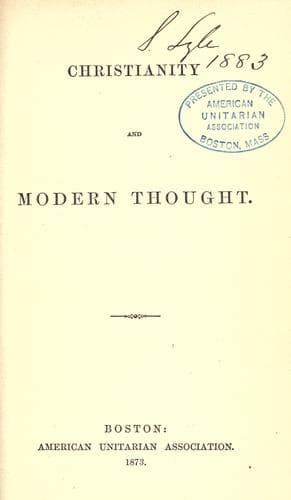
Christianity and Modern ThoughtPeabody, Andrew P. (Andrew Preston)
Religion
Christianity and Modern Thought
Peabody, Andrew P. (Andrew Preston)
Unitarianism
If the relation of Christ to his truth is so different from that of the
spirit of the age to its truth, it must follow that the two forms of
truth rest on different bases. The faculties by which the age seeks
truth must be different from those through which the truth came unsought
to Jesus. This age seeks truth by the discriminating and investigating
power of the understanding. Truth came to Jesus through the intuitions
of the soul. In him the moral and spiritual faculties were full of
strength. He lived as naturally in the world of spiritual realities as
other men live in the world of physical realities. As we need only open
our eyes and see, so his spirit had only to open its eyes and it saw. As
the voices of the outward world come to us without our listening for
them, so the voice of God came to him whether he would or no. And this
was the ground of the authority with which he spoke. Whoever speaks from
the moral and spiritual consciousness to the moral and spiritual
consciousness may and must speak with authority. We may illustrate this
by an extreme case. When a man is lurking for the commission of some
crime, or after he has committed it, he feels the mastery of all
innocent things. The rustle of a leaf may excite his dread. To a voice
denouncing his crime, or crime like his, he listens as to the voice of
God. This recognition of the mastery of a higher degree of life after
its own kind is felt at every stage of moral and spiritual development.
If the soul be comparatively guilty, it recognizes this mastery with
dread. If it be comparatively innocent, it recognizes it with joy. Such
was the authority with which Jesus spoke. Though he spoke with
authority, what he said did not rest on this authority. It was the
authority with which the awakened calls to the sleeper, bidding him
awake, for the world is bright with the morning. The voice penetrates to
the obscured consciousness of the sleeper. He stirs himself, he opens
his eyes, and rejoices for himself in the morning brightness. So Christ
called to a sleeping world. Nay, he called to those who were dead in
trespasses and sin, and they that were dead heard the voice of the Son
of Man and lived.
If the truth taught by Jesus and the truth that is sought by the present
age rest on such different bases, they must be, we should suppose, in
some respects different each from the other. But, if each be truth, they
must be the complements each of the other. And, if they are the
complements each of the other, they must need one another. Each must be
imperfect without the other. Each must find a certain confirmation and
support from the other, and each must complete for the other the circle
of truth. We are thus led to look at some points in the teaching of
Christ, and to see how these complete and are completed by the truth
which the present age seeks and finds.
Public-domain text, read in full here on John Shaqi.
Reviews
Reviews
No reviews yet
Be the first to share your thoughts on this work.
Elsewhere in the archive
Join the Discussion
Join the discussion
Sign in to leave a comment or review.
Sign InorCreate an account