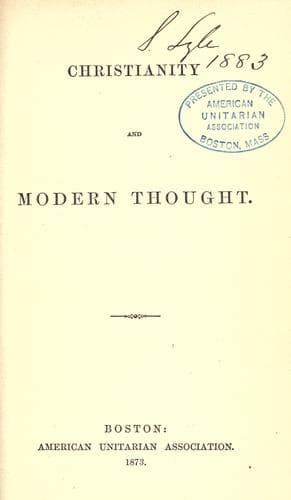
Christianity and Modern ThoughtPeabody, Andrew P. (Andrew Preston)
Religion
Christianity and Modern Thought
Peabody, Andrew P. (Andrew Preston)
Unitarianism
The result of the union of the thought of the age with the thought of
Christ may be seen in all the relations in which the soul stands to God.
Christ bade his followers preach his gospel to every creature. The age
has taught us the necessity of educating and civilizing the barbarian,
if we would christianize him. Christ taught us to love the sinner while
hating sin. This has seemed to some paradoxical; but the age has removed
some of the difficulty by showing how much of what we call character is
the result of inherited tendencies and outward circumstances. Jesus
taught the doctrine of immortality. Men have tended to look upon the
future life as something standing over against the present. The age
teaches us that such a break in life is impossible, that if there be an
immortality it must lie hidden in the present. It teaches, too, that the
judgments of God, if there be a God, are never arbitrary. He does not
hold blessing in one hand and cursing in another, and give each, by an
outward bestowal, as he may see that it is deserved. Men's acts drag
their consequences after them. Thus the old Scripture phrases are just
coming to their meaning. It is not an angry God that pursues the sinner:
it is his own sin that has found him out. Men do reap the fruit of their
own sowing. There is no scientific truth of the day that stands in any
stronger antagonism to the truth of Christ than is implied in such
antitheses as have been referred to. Even the theories of development,
so rife at present, do not stand in the way of Christ. Christ looks not
downward but upward, not backward but forward. Such theories, if
established, would only show the progressive power of spirit, the
omnipotence of life.
But if the thought of Jesus needs that of the present age, still more
does the thought of the age need that of Jesus. If the spirit needs a
body, still more does the body need a spirit. The laws, the forces on
which the thought of the age dwells, until this divineness is added to
them are hard and cold. The body, which could carry on all the functions
of its life, yet without life, would be a machine, perfect indeed and
wonderful, but a machine none the less. The thought of the age, taken by
itself, uninspired by Christian truth, tends to drag down the soul, to
imprison it in mere mechanism, to take from it its divine inspiration;
and while we need the thought of the present age to illustrate to us the
methods of God's dealings with the soul, none the less does the thought
of the age need the knowledge that there is a soul. Among all the forces
of the universe, the power of the soul, the culmination of them all, is
apt to be lost sight of. The thought of the age tends to look upon
things from without, and to lose that which is their essence. It needs
the voice that shall awaken its own inner life, and thus bring it to a
consciousness of the life that lies at the heart of all things.
Public-domain text, read in full here on John Shaqi.
Reviews
Reviews
No reviews yet
Be the first to share your thoughts on this work.
Elsewhere in the archive
Join the Discussion
Join the discussion
Sign in to leave a comment or review.
Sign InorCreate an account