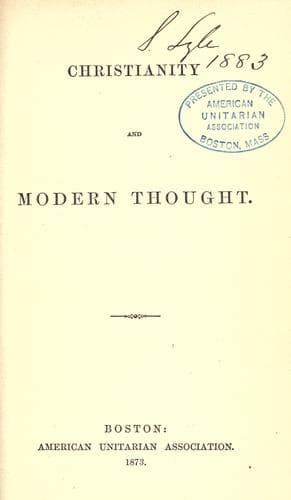
Christianity and Modern ThoughtPeabody, Andrew P. (Andrew Preston)
Religion
Christianity and Modern Thought
Peabody, Andrew P. (Andrew Preston)
Unitarianism
But does not the age in turn need this teaching? Materialism and
mechanism in thought are bad enough: they are worse in life. The life of
the age has a tendency to materialism and mechanism. The science of
political economy tends to become a hard system of rules, in which the
spontaneous sympathy of the helper and the individuality of the helped
are lost together. The eagerness of the world after material prosperity
tends to a practical absorption in these ends. Thus we have the greed,
the excitement, the madness, the display, the corruption that to so
great an extent characterize the age. We have seen that there is a
deeper life beneath this superficial one; but these evils, however
superficial, need prompt and constant care lest they eat into the very
heart. The body needs the spirit, or it will sink into decay.
I have spoken of the two elements which we are considering as if they
stood simply over against one another. This is in some respects true.
The thought and life of the age are, indeed, largely indebted to the
stimulus of Christianity; but they are not, like the painting and
architecture of the Middle Ages, the direct outgrowth of it. The science
of the present day is self-developed and self-sustained. The machinery
of the world has been invented for the world's uses. Its political
economy has been thought out to facilitate its own ends.
But though the two elements, to some extent, stand over against one
another, yet each, by its natural development, is approaching the other,
and each is becoming penetrated by the other. On the one side, religion
is catching the spirit of the age, and is approaching the clearness and
accuracy of scientific thought. On the other side, science is becoming
conscious of truth which is unattainable by its methods, and which is to
it therefore the unknowable. Already does Herbert Spencer, who
represents the foremost thought of the time, feel the awe of this
mystery, and see gleaming through it something of the presence of the
infinite love. The life of the age, also, by bringing men near to one
another, tends to produce the sense of human brotherhood. Its vast
business enterprise, in some of its aspects, does more for the cause of
humanity than many a professed charity. Further, the age is, to some
extent at least, directly inspired by Christianity. Its zeal for
humanity, its sympathy with the oppressed and suffering everywhere, its
gigantic and unparalleled charities, show it to be more truly Christian
than any age that has preceded it.
Public-domain text, read in full here on John Shaqi.
Reviews
Reviews
No reviews yet
Be the first to share your thoughts on this work.
Elsewhere in the archive
Join the Discussion
Join the discussion
Sign in to leave a comment or review.
Sign InorCreate an account