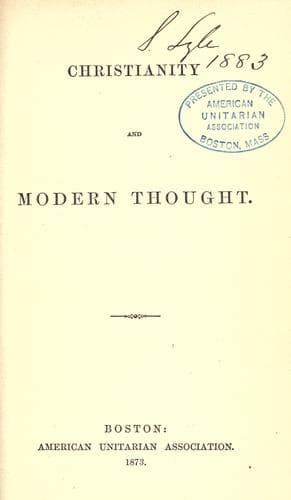
Christianity and Modern ThoughtPeabody, Andrew P. (Andrew Preston)
Religion
Christianity and Modern Thought
Peabody, Andrew P. (Andrew Preston)
Unitarianism
When Dr. Strauss, thirty-five years ago, in his "Life of Jesus,"
advanced and applied to the narrative of the New Testament a theory of
interpretation, in principle the same with that which a Christian Father
of the third century had employed in his treatment of the Old, the
theological world was profoundly shocked by what seemed to be the last
impiety of criticism. A hundred champions rushed with drawn pen to the
rescue of the old interpretation of the text. The truth of Christianity
was supposed to be assailed; the belief in Christianity as divine
revelation was felt to be imperilled by a theory which substituted
mythical figment for historic fact. That no such harm was intended, or
was likely to ensue from his labors, the author himself assures us in
the preface to that extraordinary work. "The inner kernel of Christian
faith," he declares, "is entirely independent of all such criticism.
Christ's supernatural birth, his miracles, his resurrection and
ascension, remain eternal truths, however their reality as facts of
history may be called in question."
In this declaration I find a fitting text for the following discourse.
How far does the cause of Christianity depend on the facts, or alleged
facts, of the Gospel narrative? Or, to state the question in other
words, Is the truth of Christianity identical and conterminous with the
literal truth of its record?
It is obvious at the start that a certain amount of historic truth must
be assumed as implied in the very existence of any religion which dates
from a personal founder whose thought it professes to embody, and whose
name it bears. Christianity purports to be founded on the ministry of a
Jewish teacher, entitled by his followers "the Christ." We have the
testimony of a nearly contemporary Latin historian to the fact that an
individual so named was the leader of a numerous body of religionists,
and was put to death by command of Pontius Pilate, in the reign of
Tiberius. But, without this confirmation, the very existence of the
Christian Church compels us to accept as historic facts, the ministry of
Jesus, the strong impression of his word and character, his purity of
manners and moral greatness, his life of beneficent action, his martyr
death, and his manifestation to his disciples after death, however that
manifestation be conceived, whether as subjective experience or as
objective reality. So much, beyond all reasonable question, must stand
as history, vouched by documentary evidence, and by the existence, in
the first century, of a church universally diffused, which affirmed
these facts as the ground of its being, and in the strength of them
overcame the world.
Public-domain text, read in full here on John Shaqi.
Reviews
Reviews
No reviews yet
Be the first to share your thoughts on this work.
Elsewhere in the archive
Join the Discussion
Join the discussion
Sign in to leave a comment or review.
Sign InorCreate an account