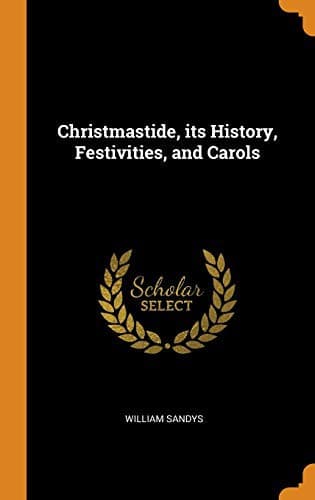
Christmastide: Its History, Festivities, and CarolsSandys, William
History
Christmastide: Its History, Festivities, and Carols
Sandys, William
Christmas
This legend is mentioned in the carol of the Carnal and the Crane. In
the hurry of the flight the Virgin Mary dropped these pieces of money
and the other gifts. They were found by a shepherd, who kept them by
him, and in after years, being afflicted by some disease incurable by
mortal aid, applied to our Saviour, who healed him, and he then offered
these gifts at the high altar. They were subsequently paid to Judas by
the priests as the reward of his perfidy. There are two reasons given
for his requiring thirty pieces of money: one that he considered he had
lost thirty pieces by the box of precious ointment not having been sold
for 300 pence, of which he would have purloined the tenth part; and the
other, that having been sent by our Saviour, on Holy Thursday, with
this amount of money, to provide for the last supper, he fell asleep in
the way and was robbed. In the midst of his distress the rich _Jew_,
Pilate, met him, and he then agreed to betray his master for the amount
he had lost.
In one of our ancient chronicles there is a legend of the life of
Judas, before he became an apostle, very similar, in many respects,
to the well-known history of Œdipus, which need not be repeated here.
When, smitten by remorse, he returned the money to the priests, and
destroyed himself: they applied half in purchase of the potter’s
field, and with the other half bribed the soldiers who guarded the
sepulchre to say that the disciples came by night and stole the body
of our Saviour. After this, having performed their mission, they were
dispersed, and all traces of them lost. They were made of the purest
gold, the term pieces of silver used in some parts of our translation
with reference to them, being, according to the history, merely a
common or generic name for money, like _argent_ in French; on one
side was a king’s head crowned, and on the other some unintelligible
Chaldaic characters, and they were said to have been worth three
florins each.
There are many old manuscript histories of these kings in existence,
at the Museum and elsewhere, one of which resolves the whole story
into alchemy; and early printed histories, as by Güldenschaiff, in
1477, and Wynkyn de Worde, in the beginning of the sixteenth century.
Some account of particularly splendid feasts on Twelfth Day have been
mentioned in the foregoing pages.
Their names were occasionally used as a term of adjuration, which, in
former times, whatever may be case now, was a mark of respect. Diccon,
in that quaint production ‘Gammer Gurton’s Needle,’ of which the plot
and catastrophe would rather astonish a modern audience, says to Dame
Chat,—
“There I will have you swear by oure dere lady of Bullaine,
Saint Dunstone and Saint Donnyke, with the Three Kings of Kullain,
That ye shall keep it secret.”
I will now conclude this chapter with the ‘Star Song,’ before referred
to—
Public-domain text, read in full here on John Shaqi.
Reviews
Reviews
No reviews yet
Be the first to share your thoughts on this work.
Elsewhere in the archive
Join the Discussion
Join the discussion
Sign in to leave a comment or review.
Sign InorCreate an account