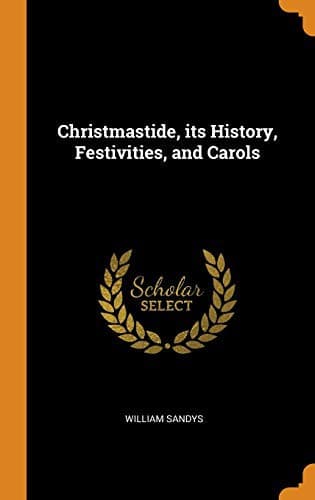
Christmastide: Its History, Festivities, and CarolsSandys, William
History
Christmastide: Its History, Festivities, and Carols
Sandys, William
Christmas
It is difficult to say whether the boar’s head was first introduced at
Christmas as a kind of anti-judaical test, because the Jews would not
eat it—something like pork was said to be eaten at Easter, together
with tansy pudding (a corruption from athanasia);—but as the boar’s
head seems to have been a favourite at all great feasts, at least, from
the time of that greatest of boars, Scrymer, it is probable that it
thus became a “chief service” at the greatest of feasts.
There are several ancient MS. carols in the British Museum,
particularly in Sloane MS. 2593 and Harl. MS. 5396, Additional MSS.
5465 and 5665 and Cotton MS. Vespasian A, xxv, of which several, and
probably the best, have been printed in Christmas carols, edited by
Mr. Wright, for the Percy Society, in 1841, and in the collection of
Christmas carols, by the author of the present work, in 1833. There
is also a curious collection of songs and carols, supposed to have
been a minstrel’s book of the fifteenth century, edited, in 1847,
for the Percy Society, by Mr. Wright, whose ability in all matters
connected with the history, customs, and antiquities of our country,
are so well known; old carols may also be found in the libraries of the
Universities. The oldest printed collection of carols was by Wynkyn
de Worde, in 1521, which contains one on bringing in the boar’s head.
Another rare collection was printed by Richard Kele, in the Poultry,
between 1546 and 1552.
In 1562, John Tysdale had a license for printing ‘Certayne goodly
carowles to be songe to the glory of God;’ and, in the same year,
Rowlande Hall had one for ‘Crestenmas carroles auctorysshed by my lorde
of London.’ In 1563, John Day printed some carols of Thomas Becon; and,
in 1569, Richard Jonnes and James Robertes, each printed a collection;
the last being by Christopher Payne. About the same time Tusser wrote
a carol, as well as other poetry, illustrative of Christmas-tide. In
1579, J. Alder had a license for ‘a Godly Hymn or Carol for Christmas,’
and in 1580, for ‘Godly Carols, Hymns, and Spiritual Songs.’ In ‘Songs
of Sundry natures,’ by William Byrd, 1589, there is a Christmas carol
which has been printed by Mr. J. Payne Collier, the distinguished
editor of Shakespeare, in Lyrical Poems, for the Percy Society. In
1597 was published at Edinburgh, ‘Ane Compendioos Booke of Godly and
Spirituall Songs,’ which contains some carols; these with the other
songs were adapted to popular tunes, the intention being to supersede
the use of profaner ballads: it was reprinted in 1801. In ‘Ancient
Scottish Poems,’ Dunbar has inserted one from the Bannatyne MS. In
1630, ‘Certaine of David’s Psalmes, intended for Christmas carolls,
fitted to the most common but solempne tunes, everywhere familiarly
used, by William Slatyr,’ was printed by Robert Young, and a similar
work in 1642. There is one also at the end of Aylett’s ‘Eclogues and
Elegies.’ In Herrick’s ‘Noble Numbers,’ 1640, there are five carols,
Public-domain text, read in full here on John Shaqi.
Reviews
Reviews
No reviews yet
Be the first to share your thoughts on this work.
Elsewhere in the archive
Join the Discussion
Join the discussion
Sign in to leave a comment or review.
Sign InorCreate an account