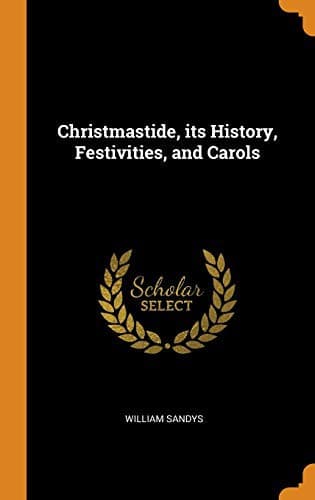
Christmastide: Its History, Festivities, and CarolsSandys, William
History
Christmastide: Its History, Festivities, and Carols
Sandys, William
Christmas
In his seventh year Henry kept his Christmas at Eltham; and in the fine
old hall there, on Twelfth Night, a castle was introduced, having in
it ladies and knights dressed in braids of gold, with moving spangles,
silver and gilt, set in crimson satin, and not fastened; the ladies’
heads and bodies being after the fashion of Amsterdam. This castle was
attacked by certain vagrant knights, who were, however, repulsed after
a severe struggle. Dancing then of course took place; and afterwards a
banquet of 200 dishes, with great plenty to everybody.
In his eighth year, there was a grand Christmas at Greenwich; and on
Twelfth Night, the Queen of Scots also being a visitor, an artificial
garden was set up, called the Garden of Espérance. This had towers at
each corner, and was surmounted with gilt rails, and the banks were
all set with artificial flowers of silk and gold, the leaves being of
green satin, “so that they seemed very flowers.” In the middle was a
pillar of antique work, all gold, and set with pearls and stones, and
on the top an arch crowned with gold, within which stood a bush of red
and white roses of silk and gold, and a bush of pomegranates of like
materials. Of course there were knights and ladies, richly apparelled,
walking in this garden; there were indeed six of each, who came down
and danced, and were afterwards conveyed out of the hall in the garden,
and the entertainments concluded as usual with a great banquet. Our
friend Richard Gybson had £130 19_s._ 0½_d._ for divers things bought
by him for this disguising.
In the following year, in consequence of the prevalence of the sweating
sickness from July to December, there was no solemn Christmas kept at
Court; but in several following years it was kept much as before, and
it will be needless to multiply examples, especially as the pageants
were in general of a less marked description.
As, in nearly every year, there were payments made to sets of players,
the highest being in general £4 to the king’s old players, who are
distinguished from the king’s players, whose fee was usually but £3
6_s._ 8_d._, it seems that during the Christmas, on what may be called
the off-nights, there were some performances by them. The children also
of the king’s chapel gave their assistance, but their services were
estimated higher, as there are several payments of £6 13_s._ 4_d._ to
Mr. Cornish, for playing before the king with them.
In his tenth year, also, the gentlemen of the king’s chapel had £13
6_s._ 8_d._ for their good attendance in Christmas, and there are
similar charges in subsequent years.
In the eleventh year there was another mask, and Richard Gybson
received £207 5_s._ 1½_d._ for the revels called “a maskelyn” at New
Hall, or Beaulieu, in Essex.
In the fourteenth year the Christmas was kept at Eltham, where the
Cardinal made many reformations in the royal household, and all that
had no masters were sent away; in modern phrase, no followers were
allowed.
Public-domain text, read in full here on John Shaqi.
Reviews
Reviews
No reviews yet
Be the first to share your thoughts on this work.
Elsewhere in the archive
Join the Discussion
Join the discussion
Sign in to leave a comment or review.
Sign InorCreate an account