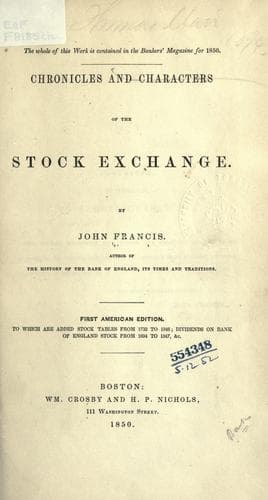
Chronicles and characters of the stock exchangeFrancis, John, of the Bank of England
History
Chronicles and characters of the stock exchange
Francis, John, of the Bank of England
Speculation; Stock Exchange (London, England)
It has been the writer’s duty in another work to advocate the cause
of the holders of unclaimed dividends. The unfairness with which they
are treated is neither to be palliated nor justified. The eagerness
and anxiety of government to obtain money is too often gratified at
the expense of morality; and it is thus with the unclaimed dividends.
Every difficulty is thrown in the way of the public; and, though the
above act distinctly ordains that, _immediately after the transfer,
the names, residences, descriptions, and amount shall be kept open
for inspection at the Bank_, it is useless for the public to apply,
as they are politely, but peremptorily, refused all information. It
is only fair to conclude that this is at the instance of government,
as the Bank receive no benefit from their violation of the act of
Parliament.
It is not often that the repudiation of a dividend causes a rise in
the price of the stock; such, however, was the case in a loan of five
millions to Austria, the interest of which was to be remitted by the
Emperor. Shortly before it became due, intelligence arrived that
Austria was unable to meet the claim. The stock at once rose two per
cent., as it was known that the faith of England was pledged to the
fundholder, and that henceforth the interest must be provided by the
English government.
A laudable endeavour was made in 1821 to abolish the system of
gambling known as options; and, after a serious consideration, the
committee of the Stock Exchange resolved, that any member guilty of
the practice should be expelled the house. It was soon found that
rules are more easily made than followed; and a powerful opposition
was organized, in which the Hebrew party took the lead. Large sums
were subscribed towards the erection of a new building; and the
schism grew so serious, and numbered such important parties in
its ranks, that the committee deemed it wise to make an amicable
arrangement, and abandon the resolution they had so hastily made.
Up to 1822, the Royal Exchange was the theatre in which business in
the foreign funds was transacted. When, however, this business became
a feature of sufficient importance, a foreign Stock Exchange was
formed in connection with Capel Court.
A very important question became mooted concerning these loans. On
several occasions, when bargains for time were made, and the loser
refused to pay his differences, the broker made them good, believing
his principal was not liable under the act of Sir John Barnard. At
last the question was legally argued; and it was ascertained from the
decision of several judges, that the provisions of the above act did
not extend to loans for foreign countries.
Public-domain text, read in full here on John Shaqi.
Reviews
Reviews
No reviews yet
Be the first to share your thoughts on this work.
Elsewhere in the archive
Join the Discussion
Join the discussion
Sign in to leave a comment or review.
Sign InorCreate an account