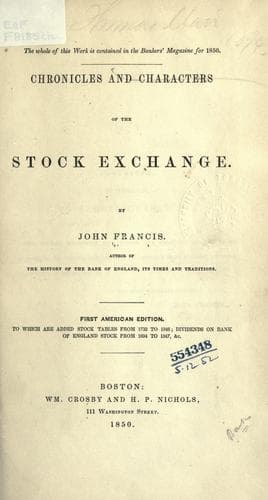
Chronicles and characters of the stock exchangeFrancis, John, of the Bank of England
History
Chronicles and characters of the stock exchange
Francis, John, of the Bank of England
Speculation; Stock Exchange (London, England)
At the formation of another mining company, the utmost magnanimity
was evinced. Rules were passed that none of the directors should
hold more than 200 shares, that all which remained should be brought
honestly into the market, and that every thing should be fair. But
this moderation waxed weaker as their power increased. Thousands of
shares were allotted among the managers, and locked carefully up. A
resolution was passed, that no director or officer should be required
to pay deposits; and then, employing the most respectable brokers to
purchase 1,000 shares with the money of the company, they created
a sensation in the market, and sent them to a premium. The person
who sold the mines to the company was employed to report upon their
value. Opinions the most flattering were given of property absolutely
worthless; and, as a proof of the greediness of one party and the
incapacity of the other, it may be mentioned that a mine, the full
value of which was £400, was purchased at £11,000; and that £121,000
were paid for some which, in almost every instance, were exhausted.
When the Lower Rhine Steam-Navigation Company was announced, it
became a great favorite. Large quantities were sold for the account;
and, as the settling time approached, the premium rose to 28. The
sellers were unable to deliver the shares, and their difficulties
became serious. To meet them, new receipts were printed, closely
imitating the old, the name only of the banker being changed. The
deceit was discovered. A committee sat to elucidate the fraud, and
the supposed concoctor was expelled from the Stock Exchange. The
circumstance excited great attention at the time; and many more were
said to be implicated than it was in the power of the committee to
reach.
Another peculiar feature of the period was to be found in the loans
which preceded and accompanied the memorable era when the public was
wild to lend its capital to foreign states, and the resources of the
borrowers were scarcely regarded. The dividends of the English funds
were scoffed at; the general rate of percentage was increased in
the eyes of the many; Patagonian or Lilliputian securities, which
promised eight per cent., were eagerly looked for; and solid loans
were followed by visionary dividends.
It is a somewhat curious fact, that directly the Navy five per
cents were reduced, the people rushed wildly into new securities
to retrieve their loss, and missed in the promises of the one the
certainty of the other. In 1822, foreign states which, in some cases,
had not even attained the freedom for which they fought, became
creditors to the English public to the amount of £10,150,000.
Public-domain text, read in full here on John Shaqi.
Reviews
Reviews
No reviews yet
Be the first to share your thoughts on this work.
Elsewhere in the archive
Join the Discussion
Join the discussion
Sign in to leave a comment or review.
Sign InorCreate an account