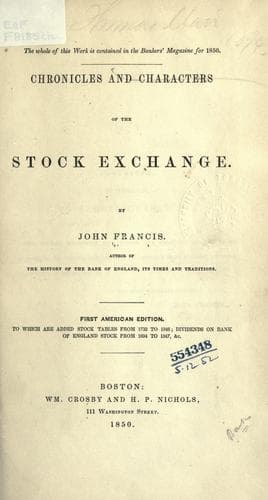
Chronicles and characters of the stock exchangeFrancis, John, of the Bank of England
History
Chronicles and characters of the stock exchange
Francis, John, of the Bank of England
Speculation; Stock Exchange (London, England)
Mr. Thompson appealed to the courts of law; but law and equity rarely
go hand in hand. The defendants contended that six per cent. was
usurious; the justice of the case was one thing, but international
law was another; and it was, therefore, a triumph,—but one which
few would envy,—when the Vice-Chancellor “confessed that the case
appeared such as would entitle the plaintiff to the equitable relief
prayed; but, as contracts for loans were illegal if the contractors
were at war with an ally of England, it could not be entertained as a
subject of suit.”
It is not to be wondered at that this willingness to lend found a
corresponding willingness to borrow. It was not alone the South
American states that came into the market; nor was it only republican
dictators who were anxious to borrow. Denmark accepted £3,000,000,
Portugal took £1,500,000, and Russia £3,500,000.
From this period up to 1825, loans to foreign places—foreign powers
they cannot be called—were very frequent. Brazil borrowed £3,686,200
in 1824, and in 1825 two millions more. Buenos Ayres followed the
good example, received one million, and then omitted to pay the
dividend; while Mexico took £6,400,000. The emancipation of this
country from the yoke of Spain was a fair specimen of the liberal
principles of the Liberals of this period. Augustin Iturbide matured
a plan to emancipate Mexico; and, having expelled the Spaniards,
established a regency, nominated by himself, formed of his own
creatures, and controlled by his own will. The army was with him, the
usurpation of the throne followed, and the dictator was proclaimed
emperor. The crown was made hereditary, his sons were to be princes,
a million and a half of dollars were settled on him, and all the
accessories of royalty were established.
A million and a half of dollars were more easily voted than procured.
Money was scarce, and the new emperor exacted it with severity. The
people grew disgusted; the opposition saw its time; disaffection
spread to the troops; and Iturbide tendered his resignation to the
senate he had formed. It need scarcely be added, that the dividends
were as difficult to get from Mexico as they were from Peru.
But the Greek loan was the most extraordinary feature of the period;
and with it is concluded the present rapid sketch of the bubbles of
1825.
Public-domain text, read in full here on John Shaqi.
Reviews
Reviews
No reviews yet
Be the first to share your thoughts on this work.
Elsewhere in the archive
Join the Discussion
Join the discussion
Sign in to leave a comment or review.
Sign InorCreate an account