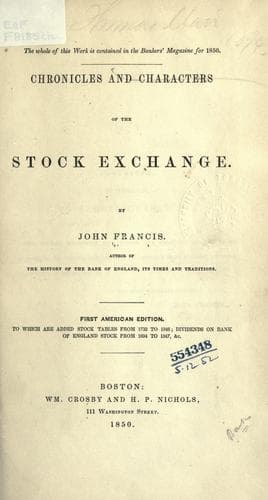
Chronicles and characters of the stock exchangeFrancis, John, of the Bank of England
History
Chronicles and characters of the stock exchange
Francis, John, of the Bank of England
Speculation; Stock Exchange (London, England)
He was a mark for the satirists of the day. His huge and somewhat
slovenly appearance; the lounging attitude he assumed as he leaned
against his pillar in the Royal Exchange; his rough and rugged
speech; his foreign accent and idiom,—made caricature mark him as
its own; while even caricature lost all power over a subject which
defied its utmost skill. His person was made an object of ridicule;
but his form and features were from God: his mind and manners were
fashioned by circumstances; his acts alone are public property; and
by these we have a right to judge. No great benevolence lit up his
path; no great charity is related of him. The press, ever ready to
chronicle liberal deeds, was almost silent upon the point; and the
fine feeling which marked the path of an Abraham Goldsmid, and which
brightens the career of many of the same creed, is unrecorded by the
power which alone could give it publicity. Dr. Herschel, indeed, said
that Mr. Rothschild had placed some thousands in his hands for the
benefit of his poorer brethren; but thousands spent in a career of
thirty-five years, by one who counted his gains in millions, assume a
narrow form. The Jewish code prescribed a tithe; but Jewish laws are
often abrogated, when Jewish ceremonies are closely followed.
At last the time arrived which proves a millionnaire to be a man.
Mr. Rothschild’s affairs called him to Frankfort, and he was seized
with his last illness. The profession there could do nothing for him,
and, scarcely even as a last hope, Mr. Travers, the eminent surgeon,
made a rapid journey to see if English science could avail the dying
Crœsus. The effort was vain, and the inevitable fate was well and
worthily met. There appears even a certain degree of dignity in his
resignation to the last struggle, and something touchingly manful
in the wording of the will which was to surrender to others the
gold won by the sweat of his brain. Breathing an almost patriarchal
simplicity, it recommends his sons to undertake no great transaction
without the advice of their mother, of whom he speaks with tender and
even touching affection. “It is my special wish that my sons shall
not engage in any transaction of moment, without having previously
asked her maternal advice.”
The first intelligence of his death was received by the same method
which had so often contributed to his success. Beneath the wings
of a pigeon, shot in sport at Brighton, were discovered the words
“_il est mort_.” The intelligence created an intense sensation,
as the uninitiated were ignorant that his illness was dangerous,
and calculations were plentiful as to the amount of his fortune. A
greater tumult than had been produced since the violent death of his
predecessor, marked the precincts of the Stock Exchange, as it was
impossible to tell the tendency of his speculations, or what effect
might be produced by his unexpected demise.[10]
Public-domain text, read in full here on John Shaqi.
Reviews
Reviews
No reviews yet
Be the first to share your thoughts on this work.
Elsewhere in the archive
Join the Discussion
Join the discussion
Sign in to leave a comment or review.
Sign InorCreate an account