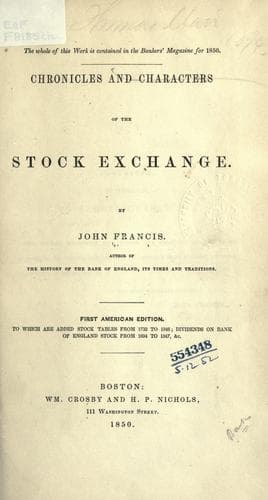
Chronicles and characters of the stock exchangeFrancis, John, of the Bank of England
History
Chronicles and characters of the stock exchange
Francis, John, of the Bank of England
Speculation; Stock Exchange (London, England)
The rules of the Stock Exchange amount in number to 159, and are
calculated to meet every difficulty. The charge to the public for
buying and selling English stock is 2_s._ 6_d._ per cent.; and the
following, taken from the third edition of Mr. Robinson’s valuable
“Share Tables,” is the commission on shares:—
_s._ _d._
Under the value of £5 1 3 per cent.
Amounting in value to £5, and under £20 2 6 ”
” ” £20, ” £50 5 0 ”
” ” £50 and above 10 0 ”
The terms used on the Stock Exchange have been in vogue for more
than a century; and the origin of many may be traced to the early
transactions in the stock of the East India Company. Buying for the
account has been described; but “bull” and “bear,” “backardation” and
“continuation,” are understood only by the initiated.
“Bull” is a term applied to those who contract to buy any quantity of
government securities, without the intention or ability to pay for
it; and who are obliged, therefore, to sell it again, either at a
profit or loss, before the time at which they have contracted to take
it.
“Bear” is a term applied to a person who has agreed to sell any
quantity of the public funds, of which he is not possessed, being,
however, obliged to deliver it against a certain time.
“Lame Duck” is applied to those who refuse or are unable to fulfil
the contracts into which they have entered.
“Backardation” is a consideration given to keep back the delivery of
stock, when the price is lower for time than for money.
“Continuation” is a premium given when the price of funds in which a
person has a jobbing account open is higher for time than for money,
and the settling day is arrived, so that the stock must be taken at
a disadvantage. In this case a percentage is paid to put off the
settlement, and continue the account open.
“Jobber” is applied to those who accommodate buyers and sellers of
stock with any quantity they require. The dealer or jobber’s profit
is generally one eighth per cent.
The “Broker” is the person employed by the public to sell or purchase
stock at a certain percentage.
“Omnium” is a term used to express the aggregate value of the
different stocks in which a loan is usually funded.
“Scrip” is embryo stock, before the whole of the instalments are paid.
CHAPTER XVIII.
_Life Assurance.—Its Benefits.—Its Commencement.—Suicide of an
Insurer.—Insurance of Invalid Lives.—The Gresham.—Sketch of the
West Middlesex Delusion._
Public-domain text, read in full here on John Shaqi.
Reviews
Reviews
No reviews yet
Be the first to share your thoughts on this work.
Elsewhere in the archive
Join the Discussion
Join the discussion
Sign in to leave a comment or review.
Sign InorCreate an account