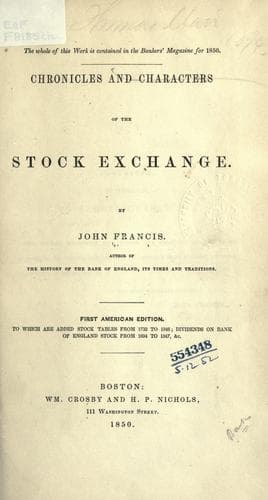
Chronicles and characters of the stock exchangeFrancis, John, of the Bank of England
History
Chronicles and characters of the stock exchange
Francis, John, of the Bank of England
Speculation; Stock Exchange (London, England)
It is believed that England is the only state in which the insurance
of lives has never been prohibited. The Dutch, a commercial people,
refused to legalize it until a recent period; and in France it was
long deemed unlawful, “because it is an offence against public
decency to set a price upon the life of a freeman, which is above all
valuation.” Another great objection was the fear that individuals
might destroy themselves to enrich their families; and though this
exaggerated view of the case is provided for in modern policies, yet
the following anecdote will prove that the fear was not altogether
groundless. So early as the middle of the eighteenth century,
the clause which excluded the representatives of suicides from a
participation in the amount insured excited attention; and an office
was established, which, for a corresponding increase of premium, paid
the amount to the relatives of the self-murderer. One man, deeply in
debt, wishing to pay his creditors, and not knowing how, went to the
office, insured his life, and invited the insurers to dine with him
at a tavern, where several other persons were present. After dinner
he rose, and addressing the former, said, “Gentlemen, it is fitting
you should know the company you have met. These are my tradesmen,
whom I could not pay without your assistance. I am greatly obliged to
you; and now——” Without another word he bowed, pulled out a pistol,
and shot himself.
The number of insurances was, at first, necessarily very limited; the
mode in which the directors transacted business, the premiums they
required, the determination to take none but lives which were almost
faultless, the pernicious plan of occasionally resisting the payment
of policies, the absence of much opposition, all tended to reduce
the business. When, however, the capital of the country increased,
and men looked earnestly about them for new modes of investment,
the profits and the principles of life assurance were anxiously
investigated, its demands inquired into, its difficulties overcome;
and though from 1706 to 1806 nine offices had been found sufficient,
yet from 1806 to 1846 the desire spread so rapidly, that no less
than one hundred and eleven were established. In 1820, there were
only twenty offices in the United Kingdom; in 1830, their number was
exactly doubled; in 1840, they had again doubled; and from 1840 to
1845, they increased in the same proportion.
Public-domain text, read in full here on John Shaqi.
Reviews
Reviews
No reviews yet
Be the first to share your thoughts on this work.
Elsewhere in the archive
Join the Discussion
Join the discussion
Sign in to leave a comment or review.
Sign InorCreate an account