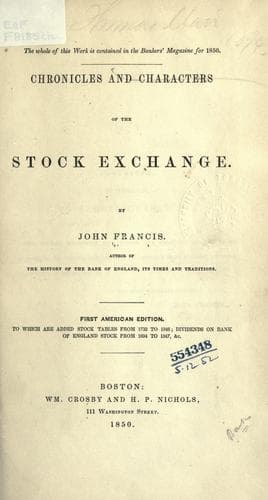
Chronicles and characters of the stock exchangeFrancis, John, of the Bank of England
History
Chronicles and characters of the stock exchange
Francis, John, of the Bank of England
Speculation; Stock Exchange (London, England)
Many instances might be given of the value of this society; and
the writer trusts that the few lines in which he has honestly and
earnestly indulged, for the sake of pointing attention to those
offices which he deems deserving notice, may be regarded in the light
in which they are written.
The cause of life assurance has occasionally received severe blows;
and though, perhaps, less fraud has been attempted in these than in
other companies, yet there is one instance of deception, so boldly
planned and so successfully executed, as to stand out in strong
relief in the history of life assurance.
About the year 1837, the provincial papers were filled with
advertisements, drawing attention to the peculiar claims of the
Independent West Middlesex Life and Fire Assurance Company. Its
capital was stated to be one million; it was declared to be a legal
corporation; and Acts of Parliament, dated from 1696, were boldly
quoted. Cautiously did the promoters proceed in the metropolis,
where they did not at first advertise, contenting themselves with
establishing agencies in various parts of the country, and publishing
advertisements in country papers. An imposing array of names as
directors, declared to be of the first character and respectability,
was promulgated; and when such names as Drummond and Perkins appeared
in the list, the uninitiated believed the one to be the great banker,
and the other the rich brewer, bearing the same names. To add to the
delusion, the Bank of England was advertised as their bankers; and
when they opened handsome premises in London, Dublin, Edinburgh, and
Glasgow, the minds of the many were thoroughly deluded. Some notion
may be formed of their intention from the fact, that they not only
insured lives on smaller premiums than other offices, but gave larger
annuities for smaller sums. According to their tables, a man of
thirty, by paying £100, could obtain £8 yearly, and could insure his
life at £1 15_s._ per cent.; thus making a clear interest of £6 5_s._
per annum.
The deed of the company—for, strange to say, it had a deed—was signed
by any one who chose; and the law-stationer applied indiscriminately
to all who came near him. Any one who asked for a situation was made
a governor. A schoolmaster, who requested a clerkship, was made a
director. An errand-man was employed as manager. A boy of sixteen
was appointed to a seat at the board. One director had been tapman
to a London tavern; another had been dismissed from his employ as a
journeyman bell-hanger; a third had been a gentleman’s servant; all
had orders to dress well, to place rings on their fingers, and adorn
their persons with jewelry; fines being instituted if they omitted to
wear the ornaments provided.
Public-domain text, read in full here on John Shaqi.
Reviews
Reviews
No reviews yet
Be the first to share your thoughts on this work.
Elsewhere in the archive
Join the Discussion
Join the discussion
Sign in to leave a comment or review.
Sign InorCreate an account